Operators say electric buses make more profit, cut costs

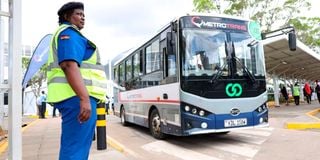
A public service electric bus passes a police officer near Jomo Kenyatta International Airport in Nairobi on November 1, 2023.

Photo credit: File | Nation Media Group

Electric vehicles (EVs), once dismissed as a far-fetched dream for Africa’s chaotic matatu industry, are now carving a niche and redefining the systems that have sustained Kenya’s public transport for years.

Today, it is not unusual to spot electric matatus gliding through Nairobi’s Central Business District (CBD) and along major commuter routes, a clear testament that electric mobility is slowly but steadily reshaping Kenya’s public transport landscape.
Unknown to many, however, at the silent revolution’s steering wheel are a handful of homegrown e-mobility startups, each charting distinct paths towards the same goal.

BasiGo, arguably the most visible, has lowered entry barriers for matatu operators through a lease-based model, where operators place a deposit of between Sh1 million and Sh1.5 million, and then pay Sh65 per kilometre to cover energy, maintenance and part of the financing.

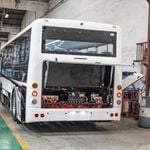
An E-Moti bus parked at the Roam Bus Park in Nairobi.

Photo credit: Pool

“Our model is a lease model. Technically, we own the bus, and the operator pays per kilometre. We handle charging, service and maintenance,” explains BasiGo managing director Moses Nderitu.

He notes that operators often make net monthly profits of between Sh150,000 and Sh200,000 and break even within six to eight months—far quicker than the four years it typically takes to repay a diesel bus loan.

But BasiGo is not alone. Roam, another assembler in Kenya, is pursuing a different approach, offering operators full ownership and lease-to-own financing in partnership with Saccos and banks.

“Our focus is on giving operators flexibility. They can resell, repurpose or fully own their vehicles, while we provide charging infrastructure and aftersales support,” says Kenya Country Manager Habib Lukaya.

Unlike BasiGo, Roam sources bodywork and components locally, a move that trims costs and cuts import delays, although Lukaya admits scaling is slowed by limited working capital.

The uptake of these models is already visible among Nairobi’s busy commuter Saccos. Outer Ring Matatu Association (OMA Services) is one of the first to go fully electric, retiring its diesel buses in favour of BasiGo EVs.

Interior view of a BasiGo electric bus photographed on August 15, 2024, at the Kenya Vehicle Manufacturers plant in Thika.

Photo credit: File | Nation Media Group

With 12 buses already on the road and 68 more reserved, Sacco CEO George Githinji says the transition has improved returns, cut costs, and boosted passenger appeal.

“Every time we get EVs, we retire the diesel cars. It improves our returns and reduces costs,” says Githinji, adding that battery maintenance handled by BasiGo significantly de-risks operators.

Other Saccos, including Super Metro, Embassava, Forward Travellers and ATS, have also joined the shift, with several now piloting inter-city electric matatus on routes such as Nairobi–Thika, Nyeri–Nyahururu and Nakuru–Nyahururu.

Beyond Saccos, smaller startups are proving EVs can work at scale. E-Moti, a Nairobi-based, tech-powered transport service provider operating a purely electric fleet, has found commuters drawn not just to the greener image but to quality of service.

“Commuters value safety and reliability above everything else. Features like air conditioning, Wi-Fi and quieter rides make EVs popular. With our current capacity, we can only manage about four trips a day before recharging,” says E-Moti co-founder Billy Mwangi.

A Roam Move electric shuttle bus at Green Park Bus Terminus in Nairobi on October 18, 2023.

Photo credit: File | Nation Media Group

Despite constraints, Mwangi says their pilot on the Nairobi–Kitengel route delivered a 16 percent net profit in the first year without external capital, demonstrating that EVs are financially viable even for small operators.

The experience of both large Saccos and smaller startups has highlighted the central bottleneck: infrastructure. While demand for electric buses is strong, rollout is constrained by local assembly pace and the availability of charging depots.

BasiGo has tied new deliveries to the commissioning of charging stations, while Roam is installing chargers in Sacco yards to ensure buses can return to service quickly.

Battery range

Operators say the shift has already forced changes in fleet management. Routes are mapped with charging in mind, schedules are adjusted for battery range, and drivers trained to optimise power use.

OMA, for instance, has linked its fully digital fare collection system to live fleet monitoring, giving managers real-time data on revenue, energy consumption and route performance.

For financiers, early numbers are beginning to prove the case. A matatu that clears Sh150,000 a month under a lease model, or a startup delivering 16 percent profit in year one, provides a reference point for banks and investors previously wary of e-mobility.

Mr Lukaya argues that access to working capital is the missing piece determining how fast the market scales. “We have invested significantly in preparing our assembly operations and are now ready to scale. The main bottleneck has been access to working capital. To address this, we are engaging local financial partners to secure the resources needed for full commercial rollout.”

PAYE Tax Calculator

Note: The results are not exact but very close to the actual.