Time flies with great content! Renew in to keep enjoying all our premium content.
Prime
Alcatel unveils portable cell towers in Kenya
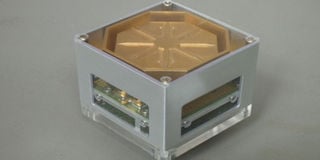
Alcatel Lucent's micro BTS innovation – a portable handheld cube approximately measuring 27 cm3 - portrays all the features of a cell tower and can be strategically mounted on poles, sides of buildings or street lights. Photo | Courtesy
Global telecommunications provider Alcatel-Lucent has unveiled its miniature base station called lightRadio which would replace the costly base transceiver stations (BTS).
The micro BTS innovation – a portable handheld cube approximately measuring 27 cm3 - has all the features of a cell tower and can be strategically mounted on poles, sides of buildings or street lights.
The lightRadio antenna may effectively mark the death of the giant BTS towers dotting the country – which incur huge fuel costs and require land - by offering a new solution that the firm says will reduce the cost of setting up base stations by up to 75 per cent.
“This flexible architecture is most suitable for Africa where most people rely on wireless mobile data whose demand continues to grow,” said Mr Tony Wood, the chief executive of Alcatel-Lucent East Africa at the debut launch of the mobile BTS in Nairobi.
The latest data from the Communications Commission of Kenya show that mobile data and Internet subscriptions account for 98.7 per cent of total subscriptions, a trend that has been steadily growing over the years.
“The lightRadio network adds capacity intelligently, and at lower cost. Mobile service providers can increase hotspot capacity by up to 10 times.”
Telecom providers are facing growing opposition from residents when erecting of communication masts in neighbourhoods due to health concerns and fear of possible exposure to electromagnetic emissions associated with such installations.
The development of a small cell tower therefore is likely to come as good news to both telecoms and consumers as they would both reap the benefits of lower costs, of setting up infrastructure and faster internet speeds.
The lightRadio technology was first conceptualised by Alcatel-Lucent in 2011 and was first piloted at the Mobile World Congress held in Barcelona, Spain in February this year (2012).
The firm says the new solution is ideal for places with limited or no copper network, and can also provide support to existing communication masts to meet the ever increasing demand by hand held devices for data.
The telecoms giant declined to disclose the cost of the lightRadio moveable tower, but said that it will soon pilot test the facility in the country and make it commercially available by the end of this year.
Mobile telephony firms have previously quoted the total cost of setting up a BTS at Sh1.08 billion ($13,000) and a further estimate of annual fuel costs of up to Sh3 million especially for off grid towers.
“The flexibility of this technology is that a provider can respond flexibly to data demands and growth without the need for capital intensive BTS,” the firm said.
The cube-like towers can be stacked together and be connected to a central device from where network activity can be monitored.
“For example, if there is a football match at Nyayo Stadium, a provider can easily deploy lightRadio devices around the arena to match anticipated data requirements and uninstall them after the match,” said Mr Wood.
Telecoms industry experts reckon that this last-mile technology will be instrumental in providing a backbone to connect rural areas. It will also help quench the increasing thirst for data by urban consumers.
Unlock a world of exclusive content today!Unlock a world of exclusive content today!