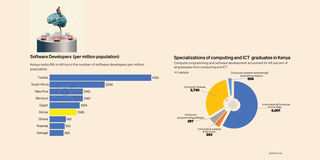
The concentration of software engineers relative to population in Kenya is Africa’s sixth highest, with 1,095 techies in every one million people, highlighting the country’s rising digital talent momentum.
Kenya’s concentration of techies is placed behind Tunisia, which has 4,120 developers per a million people, South Africa (2,234), Mauritius (1,345), Morocco (1,345) and Egypt (1,224).
The rising generation of software engineers is shaping Kenya’s innovation narrative as the digital layer becomes central to payments, logistics, agriculture, retail, energy and health delivery, among others.
Data from the Commission for University Education (CUE) shows that computer programming and software development contributed 4.6 percent of all graduates to the computing and ICT cluster during the academic year ended April 2024.
This signals that more students are moving into specialised technical workstreams that have high scalability and direct commercialisation routes.
Kenya currently has 18 institutions of higher learning formally teaching artificial intelligence (AI) and machine learning, amplifying deep tech capacity building at a time global capital is increasingly prioritising proprietary models and advanced applied research talent.
More developers are also opting for on-demand work rather than traditional employment, with Kenya’s gig share at 56.1 percent, signalling a structural shift towards more flexible digital labour models.
This has compelled software companies to increasingly compete globally for local engineers, driving more engagement with dollar-paying platforms and AI-first venture labs as talent supply structurally fragments.
The fast expansion of engineering talent places Kenya in a stronger regional competitive position to capture higher volume outsourcing value rather than remaining a consumption market for global technology systems.
Earlier this year, a Future of Jobs forecast by the World Economic Forum identified tech-backed careers such as Big Data specialists, fintech engineers, AI and machine learning experts, and software developers among the roles expected to post the fastest percentage growth globally this year.
The report noted that although broad-based AI use among enterprises remains relatively low compared to more traditional technologies, adoption momentum is rising across sectors— even though progress is uneven and largely anchored on early mover industries.