Kenya exits top 100 Club in global innovation ranking

Photo credit: Compiled by John Waweru | Designed by Stanslaus Manthi

Kenya slipped out of the world’s top 100 most innovative economies, raising concerns about its ability to sustain a digital and knowledge-driven growth.

World Intellectual Property Organisation (WIPO) uses roughly 80 indicators to assemble its Global Innovation Index (GII). They cover innovation inputs such as spending on research and development, and outputs such as patents and high-tech exports.
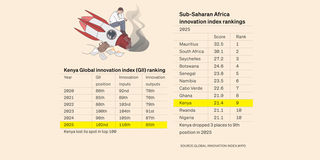
According to the 2025 GII, Kenya’s overall ranking fell six places to 102nd, its lowest position in five years. The country’s innovation inputs — which measure investment in education, research, and infrastructure — dropped sharply to 116th, even as innovation outputs improved modestly to 85th.

Kenya’s innovation input ranking has fallen 24 places since 2020, reflecting chronic underinvestment in research, human capital, and digital infrastructure.

This trend is consistent with Kenya’s broader innovation paradox: it ranks high for entrepreneurial activity and digital adoption but low on research funding, IP protection, and STEM skills development.

Therefore, despite Kenya remaining strong in entrepreneurship and creative output, it risks exhausting the momentum that once made it a continental tech leader.

Kenya’s fall coincides with a surge in innovation among its regional competitors. Mauritius, South Africa, Seychelles and Botswana dominate the sub-Saharan rankings, backed by robust institutional frameworks and stronger Research and Development budgets.

Kenya’s peak performance came in 2021, when it ranked 85th globally amid a fintech boom that positioned Nairobi as Africa’s Silicon Savannah. Since then, slowing venture capital inflows and reduced fiscal space have chipped away at the foundations of that success.

Its innovation slowdown could weigh on medium-term growth, experts say. Innovation drives productivity, competitiveness, and export diversification — all vital for cushioning the economy amid fiscal tightening.

Already, local start-ups report longer fundraising cycles, shrinking research grants, and delayed partnerships with academia. Public universities, once at the heart of Kenya’s innovation engine, continue to grapple with resource shortages.

The fall from the top 100 places puts Kenya behind regional competitors who have maintained more stable and supportive environments for business.

The decline suggests that Kenya’s early-mover advantage in mobile money and tech is being eroded by systemic failures that other nations are addressing more effectively.

PAYE Tax Calculator

Note: The results are not exact but very close to the actual.