Time flies with great content! Renew in to keep enjoying all our premium content.
Prime
Kenya gets right to tap into satellite data
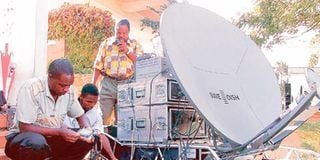
Engineers test a satellite news gathering unit. Previously, Kenya had to seek approval from Italy before being granted access to data generated by the satellite facility based in Malindi. /Peterson Githaiga
Kenya will now have access to climatic and disease surveillance data from an Italian owned satellite hosted in the country after the countries reviewed a pact signed more than four decades ago.
The deal will boost the Kenya’s response to natural disasters like floods and diseases such as Rift Valley Fever that have continued to wreck havoc on the country due to lack of early warnings systems.
Previously, Kenya had to seek approval from Italy before being granted access to data generated by the satellite facility based in Malindi, a lengthy process that has been hindering the country’s response to disasters.
Early this month the government was granted the rights to tap into the data mine without seeking the nod of the Italian authorities following the two year talks that sought to review the rules of access signed in 1962.
“This project is in our land and meant for our own interests so we have been pushing to get a stake in its management which has finally come,” Defence minister Mr Yusuf Haji told the Business Daily in an interview.
“Previously, we had to seek approvals from the Italians to access the data collected.”
Kenya has not signed access deals with other countries such the US have hosted their satellites, which besides monitoring climatic and disease patterns keep tabs of security situation in the region.
Latest satellite The US government launched its latest satellite on Kenya’s soil in November 2008 in Nairobi that is supported by the US. Agency for International Development (USAid) and the National Aeronautics and Space Administration (Nasa).
To kick off its use of the Malindi satellite, the Defence ministry has moved to establish a fully fledged national space secretariat (NSS) fashioned along the US’s Nasa in effort to boost local capacity in the use of space science and technology.
In a gazette notice on Friday, Mr Haji said the secretariat will help in the creation of a fully fledged Kenya Space agency, training of experts in space technology and help in conducting research with the view of updating the country’s space science policy.
The secretariat will also enter into pacts with other space agencies operating in Kenya and other countries for research and data acquisitions.
“It will help promote peaceful uses of space science applications including but not limited to satellite earth observations, navigation, telecommunication and disaster management,” the minister said noting that the secretariat would be based at the Defence ministry headquarters.
According to the gazette notice, Mr Haji will appoint the chief executive officer of the NSS secretariat whose membership will include Attorney General Amos Wako, Communications Commission of Kenya director-general Mr Charles Njoroge and his counterpart at the Kenya Civil Association Authority Nicholas Bodo, who is currently serving on an acting capacity.
Bad track record Others to serve at the secretariat will be the directors in charge of Military Intelligence, National Military Command Centre, Kenya Meteorological Department and department of Resource Surveys and Remote Sensing.
The rest are the Lead Scientist and the secretary, National Council of Science and Technology. Kenya has had a bad track record of disaster preparedness as witnessed in the recurrent cases of flooding in parts of the country that leave scores of people dead and property lost.
Officials have also had to face embarrassing cases of disease outbreaks such as the infamous Rift Valley Fever and malaria whose spread could be avoided. through early warning systems.
Unlock a world of exclusive content today!Unlock a world of exclusive content today!