Kenya has only two artificial intelligence (AI)-capable data centres against South Africa’s five, highlighting a growing infrastructure gap that could lock the continent out of the most valuable cornerstone of the generative technology economy.
An analysis from Data Centre Map, a global data centre directory, shows that South Africa leads Africa with 60 data centres, followed by Nigeria with 22 and Kenya with 19. But most of these centres lack AI capabilities.
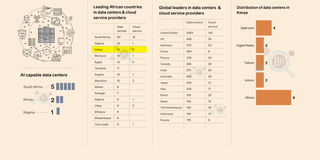
South Africa only has five, which are AI-capable, while Nigeria has one.
While AI promises to be a powerful tool in boosting productivity, Africa is being left behind because it lacks the digital infrastructure, including connectivity in the form of fast fibre-optic broadband.
The lack of connectivity is compounded by a shortage of the heavy-duty data centres needed to crunch the masses of data required to train large language models and run the AI-powered applications that could boost Africa’s economic growth.
These days, much of the content and processing needed to keep websites and programmes running is held in the cloud, which is made up of thousands of processors in physical data centres.
Yet Africa has far fewer of these than any other major continent.
Fifteen of Kenya’s 19 data centres, mostly light-duty, are located in Nairobi.
Data Centre Map indicates that Kenya is ahead of Morocco (14) and Egypt (13), as well as Tanzania (11) and Angola (10).
Globally, there are 10,793 data centres listed across 174 countries.
The United States alone hosts nearly 40 percent of them, cementing its position as the engine room of the AI economy. The UK follows the US with 498, while Germany comes third with 470.
The AI infrastructure race is dominated by countries with deep capital markets and established hyperscale cloud ecosystems. These markets are also home to the largest cloud and chip players, which means they control not only the software layer of AI but also the hardware, from GPUs to specialised data-centre networking.
Without such infrastructure, African firms and governments are forced to rely on overseas cloud regions, meaning the continent risks becoming mainly an importer of AI services rather than a producer of the technologies that will shape future productivity and competitiveness.