It is midnight in Samburu. I lie on a star bed set deep in the wilderness. No walls; just a bed surrounded by rocks, acacia trees and mountains, wind moving through.
Above me, almost every inch of the sky is draped in stars, too bright perhaps.
In Samburu, the skies are clear. The nights, although hot, get utterly dark. In this pitch blackness, clean air, you feel like the world has stopped. Unlike the day, when hundreds of birds roam, some chirping, others strange and cooing, at night, there is only silence; deep silence.
It is these very dark night skies and a blanket of stars that are increasingly attracting a new kind of tourists to Samburu: stargazers, some international, a few Kenyans. The star bed is set on a rock cliff in Saruni Basecamp, a luxury lodge in Kalama Conservancy that covers about 200 acres.
In this bed, you feel so tiny, in a dry land full of rocks and leafless, dry acacia trees that stretch as far as the eye can see.
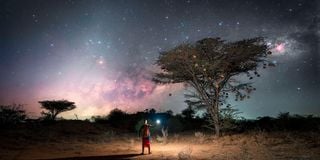
Views of the Samburu night sky from a star bed in Kalama Conservancy.
Photo credit: Pool
Far ahead, there are many small mountains, the big, sacred Mt Ololokwe and peaks that look like silhouettes against the night sky.
I lie awake until 3am watching stars, as the wind brushes softly against my body. I try to spot Pisces. Twin Brothers. The Zodiac light. The Nine Sisters. The dog. The Orion’s Belt. The Milky Way.
Not that I knew much about astronomy, or even remembered my Geography lessons, but Benson Oldapash, the Basecamp Samburu manager, had just shown me a universe I did not know existed.
“Stargazing in Samburu is hardly a modern discovery and selling it as a destination for the stars felt almost effortless,” Mr Oldapash told BDLife.
“From a young age, Samburus have been using stars to tell when it would rain; during the drought season, because some stars brighten during a prolonged drought. When the people saw a lunar eclipse, no one slept. The next morning, we’d all shave our heads in readiness for a funeral, because that meant that someone might be dead somewhere. For instance, when we spot the Seven Sisters [a star cluster which you can easily spot without a telescope], it always means that the rain is coming soon,” he said.
The Samburu night sky, with Mount Ololokwe silhouetted in the background.
Photo credit: Pool
Hotels in Samburu are now courting hobbyists and tourists seeking away-from-the-crowds destinations, and some are going as far as flying in astrophotographers to help tourists better appreciate the Samburu sky: see the celestial things they cannot see with the naked eye by taking night photos.
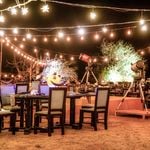
The hotels organise stargazing by the fire in the evenings, nature walks after dinner, where guests all go to a rock or the star bed.
“Some of the constellations in the Samburu night sky that fascinate tourists include Scorpio, Sagittarius, the Southern Cross and the Nebula clouds,” Mr Oldapash said.
During one of the stargazing nights, he pointed at Orion, a constellation of stars that hangs in the sky like a man who knows he is being watched. A hunter, the seasoned stargazers said.
Strong, armed with a bow and arrow, his dogs always nearby, guarding him even in the dark. The night sky was also full of Orion’s lovers, scattered around him like unfinished stories. There was “Merope”, one of the “Seven Sisters”, a quiet beauty who kept her light low. And then there was “Cassiopeia”, she shines, yes, but she never rests, turning endlessly in a W or an M, depending on the season.
“You’d find tourists who are stargazers visit Namibia, but they rarely come to Samburu. They’re not familiar with the Samburu's beautiful skies, yet it’s one of the most ideal destinations for stargazing,” he said.
Rositsa Dimitrova, an astrophotographer, pictured in Samburu on January 16, 2026.
Photo credit: Pool
I asked Rositsa Dimitrova, an astrophotographer who had travelled to Samburu to teach tourists how to shoot the night sky, what the most exciting thing to spot in Samburu is.
“The Majellanix Clouds [two irregular dwarf galaxies that orbit the Milky Way] and the Gum Nebula [a faint, pinkish glow stretching across the constellations] glow pink in the sky, but you need a good camera to truly be awed by them,” she said. “The most interesting things are inside the Milky Way and Orion’s constellation.”
One morning, we went out to spot the Milky Way Core. Waking up early while on holiday can feel unnecessary, until 4am arrives, and the thrill of a drive in the wilderness and stargazing becomes oddly difficult to ignore. This is what makes Samburu more fun, compared to other safari destinations.
From the tour van, we hoped to catch the peering eyes of “Ugali”, the leopard that frequents Kalama Conservancy. The previous night, “Ugali” had been spotted near my tent. But I had been assured that leopards are shy; they see you and hide. If I were lucky, I might catch "Ugali" and her cub, "Sukuma", staring at me in the darkness, wondering what I was.
On that night drive to find the best spot to watch stars, we never saw “Ugali”. The next day we did, at around 8.30am. But stars, we saw, lined up around the core of the Milky Way, while the red heart of the Scorpion star shone faintly in the dark.
Rositsa, an avid traveller and astrophotographer, has built a career touring many countries to shoot the stars, and sometimes the moon.
A double-arch panoramic view of the Milky Way over Samburu.
Photo credit: Pool
Before this, she was an accountant. “I started with my phone, then a very simple camera, and it just didn’t work. I signed up for different photography courses, and then one summer I found myself at an astrophotography workshop. This was about seven years ago. The moment I snapped my first photo of the Milky Way, and the moment I saw the image on my camera, I was in love. You can see much with the naked eye, but what the camera captures is so beautiful,” she said.
This was her second time in Samburu. “I live in Europe, and in Europe, we don’t have dark skies. Here, I saw the Milky Way in all its glory. From 8pm, the Milky Way core is very horizontal, which is rare to see,” she said.
We took a few shots and headed back to another hotel, Saruni Basecamp, the second hotel in Samburu, selling stargazing as a tourist attraction. The journey up the rocks to the hotel is breathtaking.
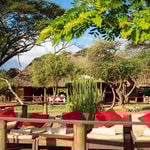
The tour van wound over rocky hills, each rock distinct in shape, colour and texture. The hotel is built atop a rock. When you sit outside your cliff room, you watch another world below; it is like you are touring the Samburu wilderness on a low-flying Cessna.
There are boulders and boulders of rocks heaped, haphazardly, but like a work of art. There is an outside bathroom. A gecko stares. Baboons with their babies on back walk by, unbothered by a human's nakedness. Here, apart from just sitting and staring at the dramatic landscape, nights are for stargazing.
Other stargazing destinations
Travel adventures focused on photographing the stars and other things in space can happen in Tenerife and La Palma in Canary Islands, Namibia, and India. “Light pollution is the main reason we can’t see the stars from cities. I’ve even heard of blackouts in US cities where people called 911, thinking something strange was happening in the sky, and it turned out to be the Milky Way.”
Of the 35 countries that Rosistsa has travelled to for astrophotography, her top destinations with the most beautiful skies are Samburu, Bolivia and Chile, because of the incredibly high-altitude skies, and Socotra in Yemen, for its remote, dark skies. "These are some of the few places in the world free of light pollution."
On the Bortle scale, which measures darkness, Samburu ranks among the few skies with minimal light and exceptionally clear views of the Milky Way, stars and celestial events. Kenya also sits at the equator, which offers visibility of constellations from both northern and southern hemispheres, a rare gift for sky-watchers.
On another early morning stargazing outing, at 4.41am, Rositsa spotted the Carina Nebula—rarely visible to the naked eye—and everyone burst into excited shouts.
“Stargazing is very therapeutic, very interesting,” Rositsa said, adding, “Looking through a camera lens, you almost see God’s creation more vividly than anyone else.
The Samburu night sky with Mount Ololokwe silhouetted in the background.
Photo credit: Pool
The best times to do stargazing? “When skies are clearest and wildlife sightings are exceptional. That is in June to October and December to March, seasons that have dramatic skies. You can see the meteor shower, when the sky briefly fills with shooting stars, flashing and vanishing almost as quickly as they appear. Some tourists came here and saw the meteor shower, they were in awe,” Mr Oldapash said.
If you are new to stargazing, where should you start?
“Begin with the planets. Look for bright, steady lights in the sky, these are usually planets. Once you spot a planet, try to identify the constellations nearby. For example, on your first evening, you might see Jupiter and then notice constellations like Orion nearby. You can also look for Pisces (the Fish) and Aquarius (the Water Bearer); Aquarius is easy to spot because of its long, distinctive “spout” shape,” he added.