Time flies with great content! Renew in to keep enjoying all our premium content.
Prime
Solar computers to spur e-learning in rural Kenya
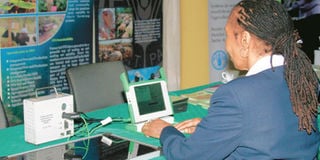
Prof Esther Kahangi, deputy vice chancellor at Jomo Kenyatta University of Agriculture and Technology, uses a solar powered laptop. Photo/LIZ MUTHONI
As the sunny season becomes welcome in Kenya with many waiting anxiously for the El-Nino rains to usher in the end of a prolonged drought, Andrew Amadi of Renewable Energy Ventures is thinking about cashing in on the prolonged sunny season by making reality the idea of solar-powered computer laboratories.
He is one of the people focused on pushing the use of computers into areas that are not connected to the electric power grid.
Could this be another wave of development in Africa, a continent blessed with constant sun?
With electricity throughout East Africa becoming patchier than usual, just when governments are trying to pep their economies up, solar provides a better option to spur projects like e-learning and growth of digital villages.
While the accurate data on the number of Kenyans who own computers will not be known until the census results are published, computer ownership and literacy is seen to have grown, an expansion only limited by lack of electric power in rural areas.
“Solar is definitely the way to go. The only problem is that because solar power is still somehow new, it is very expensive to start up. But, for communities without access to electricity, using the sun as a power resource is a great idea,” says Megan DaPisa, a member of the US Peace Corps and a teacher of the deaf.
Ms Dapisa runs a solar-powered computer laboratory benefiting 360 students including 24 deaf at Mokowe, near Manda Bay in Coast Province.
In the rural areas, where students cramp into classes with low memory computers, the interest to learn how to use computers is hampered by not only cost, but means of powering the computers.
The motivation is there; almost every secondary school graduate is increasingly enrolling for a basic computer course.
Although most of that training involves operation procedures and basic computer packages, like Microsoft Word and Excel, they are still regarded as an added advantage in developing countries for securing jobs even in the informal sector.
Emerging economies like India are known to have used such laboratories to increase computer literacy.
With Indians supplying manpower to the global ICT industry, the results are obvious.
There is evidence of income gains in Kenya because of continued use of information communication technology.
But industry players say this could change— for better—if students in primary and secondary schools are introduced to computers early in their learning.
However, access is still a major issue partly because computers are expensive in Kenya and even for some people who can afford, powering them is not possible.
Projects like rural electrification programme and villages producing own power from mini-hydro dams have not managed to connect many dwellers to electricity.
About one per cent of the rural population in Kenya has access to electricity, according to the African Energy Policy Research Network.
In Kenya, the idea of solar powered computer laboratories is still new, but has potential to grow.
The little that exists involves using household solar power sources to power computers, as a periphery to other household solar power electricity needs like lighting systems and powering radio, television and charging mobile phones.
Recently, this scenario changed with the arrival of solar-powered mobile phones.
From very basic economics, solar is expensive.
The cost of using one kilowatt hour of solar electricity is Sh30 compared to Sh16 per kilowatt hour for electricity from the national grid.
For generator engines, the cost is higher at Sh35.
Also, installing solar electricity requires one to buy batteries which are expensive. But the high cost ends here.
Interest is already showing up for such ventures.
“We will be using this laboratory for teaching and as an income-generating project in the future and will allow people from Mokowe and other nearby villages, to learn how to use computers, use the Internet, and use the printer for a small fee,” says Mr Amadi.Analysts say if massive solar-powered computer laboratories are established, it will be possible for investors or the government to apply for funding from the carbon market.
This market rewards projects which are using green concepts— technologies that reduce or do not contribute to the carbon dioxide in the atmosphere.
This forms one avenue of financing massive solar power projects.
Mr Amadi says the government and private sector should pursue the solar-powered computer laboratories option because “trying to get power to the rural areas is more expensive than setting up solar projects.”
It is estimated to cost $10,000 or Sh770,000 to extend the national grind for one kilometre only.
With additional household investment of wiring their houses, and monthly electricity bills even for schools in rural areas, the option for solar becomes reasonable.
Intel Corporation is, for instance, supporting an initiative in Nyanza’s Rusinga Island to establish a Sh3 million solar powered computer lab that will also have a mobile facility to allow it reach a large number of students.
The project will help students acquire ICT skills while at the same time conserving the environment.
The projects includes a sports utility vehicle dubbed a ‘computer-lab on wheels’ powered by solar panels and equipped with the Intel-powered classmate personal computers that will travel to rural schools offering opportunity to reach a wider student base.
“We hope that the students will get enough knowledge to explore further on their own especially if they choose to take up further computer related studies or computer service jobs,” said Alphonce Okuku, the Kenya country director of Kageno.
Other innovative options for computer laboratories can be established around the concept similar to that of Musingini area of Eastern Province, where Safaricom and Grundfos Lifelink, a division of the Danish pump-maker Grundfos Group, have partnered to implement a solar-powered, pay-for-use water vending system using the M-pesa backbone.
The solar-powered well is activated using a smart card, which permits water to flow until either the card is removed or the user’s account runs out of credit.
Villagers can use the M-pesa system to add more credit to the smart card via their mobile phones.
An initiative similar to the Sh1.3 billion deal for mobile computer laboratories for constituencies by the government could also be done for solar computer laboratories.
The project involves purchase of buses fitted with 40 computers which will go around the country teaching computers to students in primary and secondary schools.
Andrew Amadi of the Renewable Energy Ventures is one of the people who have focused on the idea of solar-powered computer laboratories— pushing the use of computers into areas that are not connected to the electric power grid.
Unlock a world of exclusive content today!Unlock a world of exclusive content today!