Time flies with great content! Renew in to keep enjoying all our premium content.
Prime
Artists seek alternatives as industrial needs exert pressure on soapstone
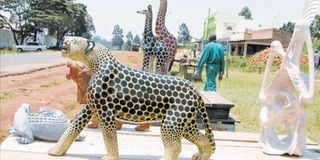
Animal soapstone carvings for sale at Nyabigege trading centretargeting passengers plying Kisii-Rongo road. Carvers have begun use granite for their work as soapstone deposits get depleted on rising demand by construction industry who use it as a raw material. JACOB OWITI
Sitting in a workshop in Nyabiginge, Kisii County, Ms Rose Biaki works on her latest soapstone piece. It is called love knot and she has been making them for the past 20 years.
She is just one of the dozens of artisans in the workshop working on various handicraft projects.
Soapstone carving has been one of the pillars of Kisii County’s economy for generations. The resource, which is unique to the region, has created employment for hundreds of young people and makes up a large portion of the county’s revenue.
Over the past few years, however, all has not been well, and the industry has taken a turn for the worse. Soapstone deposits have started to dwindle as industrial demand for raw material increases. Makers of ceramic tiles and chalk are just a few examples of industries whose insatiable need for soapstone is endangering the resource and threatens the livelihood of the thousands of families, which depend on it.
It is in this backdrop that the region’s artists and craftsmen have been forced to return to the drawing board and come up with measures to salvage an industry that is more than just a source of income to them. Several kilometres from the workshop, at a centre in Tabaka division, 15km from Kisii town, an international month-long symposium has just come to an end. The symposium, Africans Stones Talk, was convened to seek ways to add value to stone carving in the area and finding alternative resources to soapstone.
Dennis Mogendi, 27, was one of the participants of the symposium. “Soapstone carving is the cultural identity of the Kisii people,” he says. “Other communities have fishing, farming and herding but for us, carving is what we do best.
Mr Mogendi and his colleagues are now concerned that this age old economic tradition is on a fast decline and headed for collapse.
“I inherited this craft from my father who inherited it from my grandfather and so on. Such is the case with most of the artisans here,” he offers. An increase in the number of middlemen and hurdles in obtaining soapstone have led to a sharp rise in the cost of production eroding their profits.
“Ten years ago an abstract piece about ten by three inches could fetch between Sh2,000 to Sh2,500”, he explains. “Today if you made a similar piece you will be lucky to make Sh200,” he says. This has greatly demoralised soapstone artists in the region with many youth abandoning the craft altogether and moving to nearby towns in search of formal employment.
Mr Gerald Motondi is one of the organisers of the symposium. The renowned sculptor, who won a gold medal in the 2008 Olympics for one of his creations, spoke to the Business Daily. “Stone carving is mostly considered a reserve of un-skilled, small-scale artisans”, he said. “The symposium sought to find means of adding value to the trade despite the challenges we are facing.”
He adds: “Soapstone is preferred by many since it is easy to shape and one can use rudimentary tools to create a piece. That is partly the reason why it lends itself to so many people in this county, which is mostly rural.”
However, Mr Motondi says, this soft quality is also its major weakness because sculptures made from soapstone cannot last for long outdoors. “It can’t be used to make for example garden sculptures, which are on demand and fetch a lot of money,” he says.
One of the alternatives identified that could replace soapstone and increase the value of stone carving in the region is granite. Most of Nyanza and western Kenya is dotted with granite rocks sitting idle despite their economic potential. “We are trying to train our people to tap this free resource and make valuable sculptures,” he says.
Mr Motondi says working with granite demands the use of electronic tools and long hours shaping and smoothening the rock to the desired shape and form. “The returns are, however, very high because once completed a single well done sculpture could fetch up to Sh1 million.” George Kockott, a sculptor from South Africa who has been working with granite, attended the symposium to educate his Kenyan counterparts on how to use the rock to create wealth.
“What is happening in stone carving in Kenya is that a lot of emphasis is laid on craft and lesser emphasis on art, which is more valuable,” he explains. “The difference is anyone can make a craft but few people can make works of art. This gives art more intrinsic value because of its uniqueness and its connection to the cultural heritage and nature”.
Mr Kockott says thousands of people make millions of handicraft and this limits the market because of high supply, which lowers the value of the works involved. “This is what is happening to the soapstone industry in Kisii. People are under cutting one another and in turn drastically reduce the value of the whole industry,” he says.
For new sculptors, the start-up costs are quite high, given the specialised tools required. One requires a diamond blade saw, several sets of diamond-lined smoothening pads and diamond tipped chisels. Add the costs of protective gear and transporting the rock and one is looking at capital investment of between 80,000 and 100,000. “If you are a new sculptor most of your monetising would be in form of a trial and error basis. You try it out with the first piece and if it gets a buyer you raise the price on your next piece ... The more you sell the more valuable your work becomes”, says Mr. Kockott.
“In South Africa, there is a lot of governmental and institutional support. We are given the incentive to derive the most value out of our creations but I haven’t seen much of that here in Kenya.”