Time flies with great content! Renew in to keep enjoying all our premium content.
Prime
Central bank sets aside Sh7 billion for legal claims
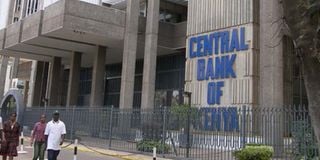
The Central Bank of Kenya headquarters in Nairobi. CBK has set aside Sh7bn in the just concluded financial year to pay for unexplained legal claims. FILE
Central Bank of Kenya (CBK) has set aside Sh7 billion in the just concluded financial year to pay for massive unexplained legal claims.
The financial sector regulator, currently embroiled in a multi-billion-shilling fake bond scam, declined to disclose the source of the exposure in email communication with the Business Daily.
So far, the only publicly known high-value claim remains that of Oriental Commercial Bank. Oriental, formerly Delphis Bank, which was owned by controversial businessman-turned-preacher Kamlesh Pattni, has put a Sh123 million claim on CBK assets with accrued interest dating back from 1993 in a suit filed in 2011.
“The bank is party to various legal proceedings with total claims of up to Sh7.3 billion up from Sh267 million in 2012,” reads CBK’s annual financial statement.
In the last two years CBK had carried a flat figure of Sh266.5 million as its exposure which raises serious questions of what necessitated the sudden surge.
The regulatory body does not outline the legal suits it is facing, contrary to the practice of other corporations which detail their legal exposures. It, however, made attempts to pour cold water on the magnitude of the exposure by stating that its legal team had advised that no loss would arise from the proceedings.
The bank declined to disclose the nature of the potential claims, that providing for ties down cash that would otherwise be paid out to public coffers through dividend.
“The Auditor-General has just completed auditing the accounts and is yet to submit the same to Parliament as required by law. In this circumstances, we are not in a position to comment on the detailed aspects of the accounts until deliberated upon by the Public Investments Committee of Parliament,” said the governor, Prof Njuguna Ndung’u.
International auditing firm, KPMG, is listed as the bank’s auditor. The bank has a panel of lawyers making it difficult to trace all cases that it is currently facing.
Market players the Business Daily talked to though held strongly that the exposure could be related to fake bond transactions reported last year, with investors who were holding the money widely expected to challenge the regulator on the basis of negligence.
CBK has sued one of its employees and two others for the creation of the fake bonds, which is said to have happened when the regulator was switching to a new technology platform in 2011.
“They could face legal challenge that it was as a result of their negligence that the bond holders lost money,” said a source in the bond market who did not wish to be disclosed due to fears of reprisal from the regulator.
Fred Mweni, who is also accused of handling the fake bonds, has previously alleged that several investors were affected by CBK’s own “infidelity and impropriety” after its staff stole treasury bonds worth Sh2.6 billion.
The allegations were termed ‘grievous’ by the regulator who went ahead to seek to be enjoined in the case that had been filed against Mr Mweni by the Capital Markets Authority (CMA). It has not been clear as to who was holding the fake bonds and whether the holders were compensated.
Analysts noted that it would be in the bank’s interest to settle the matter quietly in order to protect investor confidence in the Kenyan debt market and reinforce the ‘risk-free’ reputation of the bonds.
The National Social Security Fund (NSSF), which was carrying contingent liabilities of Sh20 billion five years ago, has cut the exposure to Sh4.6 billion following out of court settlements with litigants who were largely contractors. Last year the fund paid Sh810 million to two contractors who were seeking Sh7.2 billion in settlements.
In 2008 the bank’s contingent liabilities also jumped by Sh8.1 billion, an amount relating to the foggy Grand Regency Hotel legal status. The issue was resolved in the same year with the bank selling the hotel at $45 million (Sh3.8 billion) to Libyan investors who renamed it Laico Regency.
Fine and penalty
The claim by Oriental Bank is in relation to a fine and penalty imposed on the bank following failure to honour a forex-swap transaction with the regulator.
In the case CBK says it deposited the money in Delphis’ account but did not receive the dollars in its New York Federal Reserve Bank account as per the spot-contract agreement forcing it to reverse the deposit after 56 days.
CBK followed the reversal with the imposition of a Sh6.8 million fine on Delphis Bank for forex losses, Sh10.6 million for breach of banking rules and Sh105.6 million in interest at the then prevailing rate of 65 per cent on the principal amount for the 56 days.
Delphis bank settled the claim but has sought reimbursement arguing that it was not liable for the default, which it attributes to Mr Pattni, then its client and major shareholder. The status of the case is not known publicly.
Last year, the courts awarded Akiba Microfinance Sh1 billion following a decision to irregularly close it at the height of the Pyramid Scheme scams in 2005. It is not clear if the regulator has filed an appeal against the ruling of the magistrate court.
CBK has been under pressure to reopen Charterhouse Bank which it put under statutory management following suspicion of money laundering activities.
A parliamentary committee last year recommended the reopening of the bank, whose shareholders are known to be extremely litigious, but this is yet to happen.
CBK is also involved in a tender dispute worth Sh1.2 billion awarded to Horsebridge International, a decision that was nullified by the bank’s procurement committee but upheld by the Public Procurement Oversight Authority.
Unlock a world of exclusive content today!Unlock a world of exclusive content today!