China firm’s Kiambu quarry works blocked on environment concerns

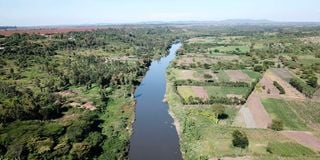
An aerial shot of Athi River passing through Kilimambogo on June 20, 2019.

Photo credit: File | Nation Media Group

A court has temporarily stopped a Chinese firm and its local partner from continuing with quarrying activities in Kilimambogo, Kiambu County, citing concerns about the environment and violations of constitutional rights.

The Environment and Lands Court orders are directed to Chinese firm Sinohydro Corporation Limited and Vallem Construction Limited, highlighting growing scrutiny over foreign-led mining projects in Kenya, particularly where local communities are sidelined.
Similar disputes arose in Kwale (titanium mining) and Kakamega (gold exploration), where human rights activists accused firms of flouting environmental laws.

The court ruled that Sinohydro Corporation and Vallem Construction must immediately cease all mining operations, including blasting, crushing stones, and excavating, or in any manner operating the quarries located at Kilimambogo.

The order remains in force pending the hearing and determination of a petition filed by a non-governmental group, the Regional Centre for Business Ethics & Research (RCBER), challenging the legality of the mining permits.

The petitioners accused Kiambu County Government of unlawfully issuing the two firms quarrying permits without conducting public participation or publishing an Environmental Impact Assessment report.

They argued that the mining activities had caused severe noise pollution, environmental degradation, and health hazards for residents.

According to court documents, residents of Kilimambogo have endured noise pollution, health hazards, and environmental degradation due to uncontrolled quarrying operations.

“The blasting and crushing of stones have caused unbearable noise pollution, while dust and debris have contaminated water sources,” the group said. “There are no proper waste disposal mechanisms, and residents suffer respiratory illnesses.”

Vallem Construction had challenged the court’s authority, arguing that disputes over mining licences should first be heard by the National Environmental Tribunal (NET) before escalating to higher courts.

However, the court dismissed the objection, ruling that the petition raised fundamental constitutional violations, including the right to a clean environment (Article 42 of the Constitution), which fall squarely under the Environment and Land Court’s jurisdiction.

The court emphasized that constitutional rights cannot be sidelined by procedural technicalities.

“Where fundamental rights are at stake, courts must intervene,” the ruling stated.

The court also found that the petitioners have a strong case against the mining activities and the county government, "with a probability of success", especially on the primacy of public participation in environmental decisions.

"The applicants have demonstrated clearly that the public participation process and the approval by the third respondent (county government) were processes that were not carried out; therefore, there was no public participation on the utilisation of a natural resource which belongs to all," said the court.

The court observed that the respondents did not deny the facts set out by the applicant, save that they claimed the court lacked jurisdiction over the dispute due to the doctrine of exhaustion having obtained approval from the county to carry out the activities.

It is the petitioner's case that the County Government issued permits without involving the National Land Commission (NLC) or ensuring compliance with environmental safeguards.

After a full hearing of the case, they want the court to quash the permits. However, the injunction remains in force until the main petition is heard and determined.

PAYE Tax Calculator

Note: The results are not exact but very close to the actual.