China floods Kenya with Sh305 billion goods as trade deficit widens

China imports

Chinese factories continue to dominate supply chains into Nairobi.

Photo credit: Shutterstock

China’s trade dominance over Kenya has deepened to a new record, with the world’s second-largest economy supplying nearly a quarter of goods into the East African nation, while Nairobi struggles to export a fraction of the amount.

Imports from China increased to Sh304.65 billion in the half-year period ended June 2025, from Sh257.70 billion a year ago, official data shows, accounting for 22.77 percent of Kenya’s Sh1.34 trillion expenditure on goods ordered from other countries.
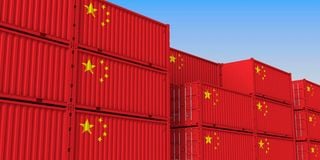
Beijing’s grip on Kenya’s imports becomes even tighter when you remove Kenya’s expenditure on petroleum products, according to data collated by the Kenya National Bureau of Statistics (KNBS), taking up 28.65 percent of Kenya’s Sh1.06 trillion non-oil import bill in the review period.

The Chinese market has traditionally been the country’s main source for a raft of goods from electronics such as smartphones and household goods to machinery and construction materials.

However, the trade flows remain heavily one-sided, with President William Ruto estimating in August that Kenya exports goods worth 5 percent of what it buys from China.

The KNBS is yet to update Kenya’s earnings from goods exported to China for the period ending June, but the value was a lowly Sh4.44 billion in the first quarter against an import bill of Sh148.62 billion.

That means Kenya sold goods worth a measly 2.99 percent of what it imported from China in the first three months of the year.

Dr Ruto has pledged to narrow the gap through a reciprocal trade deal between Nairobi and Beijing.

“We have concluded the high-level conversations with China. They have agreed to a reciprocal arrangement between Kenya and China. They have agreed to remove all the tariffs on our tea, coffee, avocado, and all other agricultural exports. That, I think, is a major breakthrough for us,” he told business leaders in Nairobi on August 6, following his State Visit to Beijing between April 22 and 26.

“... when I sat with President Xi Jinping, I had a candid conversation and I told him that Kenya is importing Sh600 billion of products from China, yet we are only exporting 5 percent. That trade imbalance is serious, that is the reason they have opened up their markets for our agricultural products.”

China seeks to position itself as Africa’s key trade partner at a time when the US and Europe are losing ground through protectionist tariff policies. Beijing in June proposed a broader plan to remove tariffs on a wider range of exports from the continent.

That could mean easier access for Kenya’s largely agricultural exports if its producers meet the scale and quality demanded by the Chinese market.

Kenya has long sought to have a bilateral trade deal with China, making access to the world’s biggest market by size a priority under the Integrated National Exports Development and Promotion Strategy, an export diversification plan unveiled in July 2018.

Nairobi in August 2018 posted five envoys to the Far East Asian region — including India, Malaysia, and Singapore —with instructions to scout for market opportunities for Kenya’s largely raw agricultural exports in China.

Before Covid-19, Nairobi had been conducting aggressive marketing campaigns in China, aimed at growing and expanding the market for Kenya’s tea and cut flowers.

The Kenya Export Promotion and Branding Agency had, for instance, announced plans to set up a centre in Wuyi, a major tea-growing area in Fujian province, and Hunan to market Kenya’s goods.

Kenyan exporters, however, continue to face hurdles of logistics, certification, and stiff global competition, while Chinese factories continue to dominate supply chains into Nairobi.

“China has 1.4 billion people, and some provinces have 140 million people. If we were to plug into 1 percent of that market for our coffee or tea, it would completely change the lives of Kenyans,” Lee Kinyanjui, the Cabinet Secretary for Investments, Trade and Industry, said in August

PAYE Tax Calculator

Note: The results are not exact but very close to the actual.