Time flies with great content! Renew in to keep enjoying all our premium content.
Prime
Food security blow as Kenya hunger levels at 25-year high
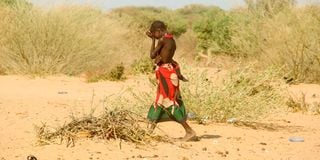
A girl wearing the Kenyan flag wanders in the bush in Illeret, Marsabit County. Thousands of learners in northern Kenya were reported to have dropped out of school during the recent drought that plagued the country.
The number of Kenyans lacking sufficient food has increased by 14.6 percentage points in less than a decade, reaching the highest level in 25 years, according to a new survey.
The 2025 Global Hunger Index (GHI) reports that 36.8 percent of Kenyans—approximately 20 million people—are undernourished, meaning they do not consume enough food to meet their basic daily energy needs.
This is a sharp increase from 22.2 percent in 2016, indicating a significant setback in Kenya's progress toward food security, and raising concerns about the country's ability to achieve its Zero Hunger goal by 2030.
The GHI is an annual, peer-reviewed report published by Concern Worldwide, Welthungerhilfe, and the Institute for International Law of Peace and Armed Conflict (IFHV).
It measures and tracks hunger globally, regionally, and within individual countries. Its mission is to inspire global action to reduce hunger.
The index defines undernourishment as insufficient food intake to meet the minimum daily energy requirements for a healthy life.
It combines four key indicators—undernourishment, child wasting, child stunting, and child mortality—into a score on a 100-point scale, with zero representing no hunger and 100 indicating extreme hunger. Kenya’s 2025 score of 25.9 categorises it as “serious”.
From 2000 to 2016, the country steadily reduced hunger levels, supported by improved nutrition programmes, stronger health services, and agricultural growth.
During this period, the country made significant progress in child health, reducing stunting from 38.6 percent in 2000 to 17.9 percent in 2024 and halving child mortality rates.
However, the increase in undernourishment reveals a growing disparity between improved child nutrition and deteriorating food insecurity among adults, highlighting deep vulnerabilities in Kenya’s food systems.
The report attributes this setback to prolonged droughts, high food prices, and declining household purchasing power.
Between 2019 and 2023, the country experienced six consecutive failed or below-average rainy seasons, devastating farms and livestock in arid and semi-arid regions.
“The climate crisis is no longer episodic; it has become a constant threat. 2024 was the hottest year on record, and extreme weather events are increasingly devastating food systems,” the report states.
Economic conditions have further worsened access to food, increasing the cost of imported food, fuel, and agricultural supplies.
A 2024 survey by the Kenya National Bureau of Statistics found that almost one in three households in informal settlements reported skipping meals or eating less due to high costs. Many families are increasingly relying on cheaper, less nutritious staples to survive.
Similarly, a survey by UN agencies found that the cost of a healthy diet increased from Sh113.86 to Sh189.48 per person per day between 2017 and 2024, putting nutritious food out of reach for many Kenyans.
Conflict and instability in neighbouring countries have also worsened Kenya's food security. Border regions such as Turkana, Marsabit, and Mandera have faced disrupted trade routes and insecurity, limiting food transportation and inflating prices.
Additionally, Kenya is home to almost 700,000 refugees and asylum seekers, primarily from Somalia, Ethiopia, and South Sudan, placing further strain on the limited resources of food-insecure host communities.
Undernourishment is unevenly distributed across the country. Arid and semi-arid areas, which are home to around 30 percent of Kenya’s population, account for almost 70 percent of those facing food insecurity.
Counties like Turkana, Wajir, Garissa, Kitui, and Makueni are particularly badly affected due to their reliance on rain-fed agriculture and poor market access. In contrast, agriculturally rich regions such as Trans Nzoia and Uasin Gishu struggle with high input costs and low returns, which discourage small-scale farmers from producing enough food, even for their own households.
Across Sub-Saharan Africa, 10 countries have experienced rising hunger levels since 2016. Kenya is now among six nations with “extremely alarming” levels of undernourishment, alongside the Democratic Republic of Congo, Liberia, Madagascar, Somalia, and Zambia.
The GHI report warns that, on a global scale, humanitarian funding for food and nutrition has declined even as the number of people in need continues to rise.