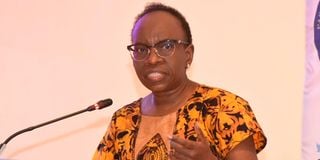
Auditor-General Nancy Gathungu has questioned the accuracy of Sh14.05 billion compensation to Judiciary staff amid uncertainty over the employment records of some 2,180 employees.
In an audit for the financial year to June 30, 2024, it was established that the Judiciary reported an additional workforce that drew remuneration, even though their recruitment records were not provided to auditors.
The statement of receipts and payments reflected employee costs of Sh14,050,247,576, which included personal allowances paid as part of the salary amounting to Sh4,894,681,873.
Ms Gathungu said that, however, personal allowances amounting to Sh182,390,324 and leave allowances amounting to Sh182,390,324 were not supported by the ledger and payroll analysis.
“...review of payroll data revealed that the Judiciary had a total of 8,330 and 6,014 members of staff as at June 30, 2024 and June 30, 2023, respectively, indicating an increase of 2,316 employees during the year,” the Auditor-General said.
“The list provided for new contracts revealed 136 additional staff members, resulting in an unsupported variance of 2,180 employees. However, the recruitment and records for the additional staff were not provided for audit review,” Ms Gathungu added.
The Auditor-General said the missing information meant that the staff costs by the Judiciary are unverifiable.
“In the circumstances, the regularity, accuracy and completeness of the compensation of employees amount of Sh14,050,247,576 could not be confirmed,” Ms Gathungu said.
Ms Gathungu also flagged other issues at the Judiciary, including unsupported foreign travel subsistence and training expenses, pending bills, failure to operationalise courts and the condemned new office building at the Mombasa Law Courts.
The Auditor-General could also not determine the accuracy and completeness of foreign travel subsistence and training expenses totaling Sh93.08 million.
“Review of records revealed payments amounting to Sh37,778,400 paid to a firm for air tickets, which were not supported by invoices and boarding passes. Further, during the year under review, The Judiciary spent an amount of Sh55,298,426 in training expenses,” added Ms Gathungu.
“However, the expenditure was not supported by an approved training plan, training needs assessment, approval, and list of employees nominated for the training.”
The Judiciary had Sh872.1 million, which was not paid to suppliers and carried forward to the financial year 2024/2025 from 2022/2023 and 2023/2024.
“The Judiciary had one hundred and seventy-five (175) courts that had been gazetted. However, as at 30 June 2024, one hundred and forty-one (141) of these courts, or 83 percent, were operational,” said Ms Gathungu.
“Among the non-operational courts were eleven (11) established in 2020 in Zombe, Borabu, Matiliku, Usigu, Kasarani, Masinga, Manga, Garbatulla, Marigat, Kikima, and Kobujoi. No records were provided outlining any plans to operationalize the remaining Law Courts.”
Ms Gathungu also raised an issue with a contract for the construction of the Mombasa law court during the financial year 2016/2017 at a sum of Sh445.2 million, where building commenced in September 2017 and a certificate of completion was issued in June 2021.
“However, audit inspection at the Mombasa Law Courts and reports from the Ministry of Lands, public works, housing, and urban development revealed that the newly constructed court building remains unoccupied due to significant structural defects which render it unsafe for use,” said Ms Gathungu.
“Further, a final structural assessment report by the Ministry dated 17 May 2024 recommended the demolition of the building due to high costs associated with repair works. In the circumstances, the public did not obtain value for money [Sh445.2 million].”