Time flies with great content! Renew in to keep enjoying all our premium content.
Prime
Global shortage of fish to lift Nile Perch exports
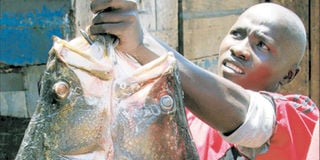
A fisherman weighs Nile Perch from Lake Victoria at Kasenyi landing site in Uganda. The lake’s fishery product exports are likely to rise due to shortage of Pangasius fish in the international market following flooding in Vietnam, its major producer. File
A shortage of Pangasius fish in international markets following flooding in Vietnam is expected to boost Nile Perch exports from Lake Victoria.
Nile Perch sales in Asian and western European markets have in past few years gradually reduced as more price-sensitive consumers opted for Pangasius, a cheaper alternative source of white meat.
Analysts with the Food and Agriculture Organisation (FAO) said Nile Perch exports from Lake Victoria could rise sharply this year following shortages of the rival species after massive floods in the main producing Vietnam contaminated ponds.
“The drop in demand for Pangasius and the increase in the value of marketing of certified Nile Perch in the EU (European Union) could give an extra boost to the fishery products coming from Lake Victoria,” the agency said in a market update for April.
The floods in the third quarter of last year saw nearly 70 per cent of all Pangasius fish processing plants in Vietnam’s Mekong delta shut down due to contaminated fish ponds mainly in Dong Thap and An Giang provinces.
The effects of the damages on the Pangasius market are expected to spill over into much of this year, reviving the Lake Victoria Nile Perch industry whose fortunes have been rising with adoption of certification programmes.
Kenya and other East Africa countries mainly rely on Lake Victoria to support their Nile Perch industries even though the business has in the recent years come under pressure from dwindling supplies and weak prices in the international market.
FAO said Lake Victoria Nile Perch exports to the EU had began stabilising due to improved quality standards.
“From January to September 2011, the EU imported 32,300 tonnes of Nile Perch fillets, showing only small decreases in volumes compared with the same period of 2010. In this period, Tanzania was by far the biggest supplier for European countries with 12,300 tonnes, followed by Uganda and Kenya,” the agency said.
Statistics showed that in the first quarter of last year, the EU remained the main market for Nile Perch with 8,200 tonnes of fillets coming from Kenya, Uganda and Tanzania.
In 2010, Kenya exported 3,600 tonnes of Nile Perch fillets to EU markets, while Tanzania sold 16,300 tonnes and Uganda 11,800 tonnes.
Apart from competition from Pangasius, the Lake Victoria Nile Perch industry has also suffered an image problem over poor fishing methods that deprived the lake of its potential resources.
Data by the Fisheries Department showed that the Nile Perch stock in Lake Victoria declined from 1.9 million tonnes to 1.2 million between 1999 and 2001 before dropping drastically to 544,000 tonnes in 2005. The stocks were estimated at 370,000 tonnes in 2008.
As part of efforts to stall the dip in Lake Victoria’s catch, governments have formed beach management units to oversee sustainable exploitation of the fish resources.