IMF urges transparency as Treasury expands its borrowing options

Abebe Aemro Selassie, Director of the African Department (AFR) at the International Monetary Fund (IMF|), speaks during a press briefing at the 2025 annual IMF/World Bank Spring Meetings in Washington DC, US on April 25, 2025.

Photo credit: Reuters

The International Monetary Fund (IMF) has urged transparency as Kenya deployed a wider mix of instruments to expand its borrowing options amid rising debt pressure.

Abebe Aemro Selassie, Director, African Department, IMF said that though it is common for countries to try and generate more resources through innovative schemes such as public-private-partnerships(PPPs), such efforts must stay open to public scrutiny.
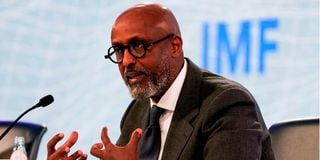
“What is fundamentally important is that assessing all of the implications that this can have, including circumventing the public scrutiny, parliamentary scrutiny, et cetera. So, we always encourage, as first order priority transparency,” he told a media briefing on the sidelines of the IMF annual meetings in Washington.

“So, beyond kind of just looking at the mechanics of how this is going to generate resources. So, we are working with country authorities that are seeking our inputs on making sure that we can understand the full implication for public finances,” the official added. during the briefing on October 16, 2025.

Kenya has lately sought to expand its debt instruments beyond the traditional Treasury bills, bonds concessional loans from multilateral and bilateral lenders, Eurobonds, and syndicated loans to raise new debt.

It recently added debt instruments, such as a Samurai bond from Japan, securitisation of statutory levies, and climate and food for debt swaps and bond buybacks amid rising budget deficits and repayment bills.

In its 2025/2026 annual borrowing plan, the Treasury said that it will prioritise non-market-based measures when managing external debt --including debt swap arrangements-- to restructure existing obligations without creating new debt, thereby alleviating medium-term fiscal pressures.

“Moving forward, the government will sustain a diversified liability management strategy, leveraging buybacks, switches, and debt exchanges, while reinforcing external debt sustainability through export growth and foreign reserve accumulation,” said the Treasury in the borrowing plan.

“External issuance will adhere to a transparent and predictable schedule, ensuring investors can make informed decisions. Instruments may include sovereign bonds, samurai bonds, sustainability-linked bonds, diaspora bonds, and other innovative debt instruments aligned with market demand and Kenya’s development priorities.”

The Treasury has already deployed some of the measures. For example, in February 2024, the government bought back a $1.5 billion (Sh194 billion) portion of a $2 billion (Sh258.5 billion), 10-year Eurobond that was due to mature in June 2024 after investor jitters over its ability to repay the debt pulled the shilling to an all-time low of Sh161 versus the dollar.

In March this year, the Treasury also made a partial buyback worth $579.6 million (Sh74.9 billion) on a $900 million (Sh116.3 billion) Eurobond that was due to fully mature in May 2027. It is planning a similar refinancing move on a $1 billion (Sh129.3 billion) Eurobond that matures in February 2028.

The Treasury is also pursuing a Sh129 billion saving on its external debt service costs through a World Food Programme (WFP) brokered debt-for-food swap, which will see participating creditors forgo their dues in exchange for Kenya investing the funds in food security programmes.

In 2024, Kenya executed a similar debt-for-climate swap with the Federal Republic of Germany, which forgave a debt of €60 million (Sh9.1 billion) on condition that the funds be invested in the 300MW Bogoria-Silale geothermal project.

Additionally, Kenya is in talks with China to convert the Sh500 billion Standard Gauge Railway loan from dollars to Chinese renminbi (RMB).

This swap, the National Treasury Cabinet Secretary John Mbadi said in August, will effectively halve the interest rate on the debt from 6.3 percent to three percent when the reference rate is changed from the US Federal Reserve’s Secured Overnight Financing Rate to a fixed Chinese currency rate.

Kenya is also pursuing PPP deals for various projects including the construction of a new highways linking Nairobi-Nakuru-Mau Summit and multiple grid connectivity ventures under the Kenya Electricity Generation Company.

PAYE Tax Calculator

Note: The results are not exact but very close to the actual.