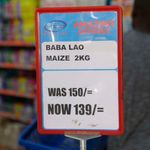
Inflation fears as standards levy on factory goods up 15 times

Supermarket

Prices of essential items, such as maize and wheat flour, cooking oil, fertiliser and medicine, are set to rise after the government published regulations enhancing the standards levy charged on nearly all manufactured products.

Photo credit: File

Prices of essential items are set to rise after the government published regulations enhancing the standards levy charged on nearly all manufactured products by 15 times to a maximum of Sh6 million.

This follows the publication of the Standards Levy Order, 2025, by the Ministry of Trade, Industry, and Investment, which caps the maximum standards levy paid monthly by large manufacturing firms at Sh4 million for the first five years, rising to Sh6 million after five years.

Unlike the existing framework that caps monthly payments at Sh400,000 regardless of turnover, the new levy order scraps the turnover basis. Instead, it pegs charges on the customs value of goods, with a higher ceiling of Sh4 million—set to rise to Sh6 million by 2030.

The regulation requires firms to pay 0.2 percent of the customs value of manufactured goods—net of Value Added Tax, excise duty, and discounts—monthly to the Kenya Bureau of Standards (Kebs).

The widening of the cap effectively broadens the tax base and significantly raises the burden on large manufacturers, especially those with heavy import dependencies.

"The levy shall be payable by all manufacturers at the rate of zero-point two percent of the customs value of the goods manufactured or services offered for sale in each month net of Value Added Tax, excise duty and discounts," reads part of the Standards (Standards Levy) Order, 2025. The Order was published by Investments Trade and Industry Cabinet Secretary Lee Kinyanjui.

The levy covers a wide range of essentials such as drugs, maize and wheat flour, cooking oil, fertiliser, animal feeds, cement, steel, beverages, bottled water, pharmaceuticals, detergents, plastics, batteries, tyres, paints, and construction materials. Industry players warn that the broad scope will push up production costs and, in turn, consumer prices.

The Kenya Association of Manufacturers (KAM), an industry lobby, has raised concerns that applying the levy across nearly all goods—including raw materials—will raise costs throughout the value chain. KAM has invited its members to submit feedback by August 21, 2025, ahead of engagements with policymakers.

The new levy comes at a time when the State is under a tight fiscal squeeze, prompting it to roll out fresh taxes and raise existing fees to bolster revenues.

In recent months, government agencies have hiked charges for motor vehicle registration, passport processing, and business permits, arguing that parastatals must become self-sufficient and less dependent on the Exchequer. Alongside new taxes such as the housing levy and the sugar levy, these measures have fuelled fears of increasing inflationary pressures.

For manufacturers, the Standards Levy piles onto existing headwinds—rising energy costs, forex volatility, and weak consumer demand. With the levy tied to customs value, firms warn it could hit hardest those sectors dependent on imported raw materials.

Government officials, however, defend the measure, saying it will strengthen Kebs’ capacity to test and certify products, align Kenyan goods with global standards, and protect consumers. They argue that the 0.2 percent rate is modest and unlikely to disrupt production significantly.

This comes at a time when legislators have questioned the legality of the new levy.

The Standards Levy was introduced by the Standards Levy Order, gazetted by the Minister for Industry through Legal Notice No. 267 of 22nd June 1990, and became operational on July 1, 1990.

However, the National Assembly’s Committee on Delegated Legislation wondered how the 1990 legal notice had been quietly replaced without fresh tabling before Parliament, accusing Kebs of sidestepping legal procedures and failing to engage the public meaningfully.

They ordered Kebs to withdraw and republish the Order, citing concerns over its legality, lack of public participation, and disproportionate burden on smaller firms. MPs accused Kebs of quietly replacing a 1990 legal notice without tabling it afresh before Parliament.

The proposed Standards Levy has been capped at Sh4 million for the five years after the start of the Order, after which it will rise to Sh6 million in another five years. Manufacturers whose annual turnover is below Sh5 million are exempt from the levy.

Failure to pay the levy will attract a late-payment penalty of five percent of the unpaid amount.

However, micro, small, and medium enterprises with an annual turnover of less than Sh5 million will be exempt from the Standards Levy.

As the State pushes ahead with fiscal consolidation, the clash between revenue demands and industrial competitiveness is set to intensify. For ordinary households, the impact will be immediate—higher prices for everyday essentials.

PAYE Tax Calculator

Note: The results are not exact but very close to the actual.