Kenya is among the top collectors of environment-related taxes (ERTRs) in Africa, underscoring its capacity to mobilise climate-linked revenue even as the limited use of pollution and resource levies lags those of its peers.
An ERTR is a levy imposed on items or services that have a potentially harmful impact on the environment. The taxes are meant to make polluters pay for the negative products they produce and encourage them to adopt sustainable practices.
In Kenya, the ERTRs are presently primarily excise duties on petroleum products. There are also new levies proposed under the draft National Green Fiscal Incentives Policy Framework, which targets a host of new ERTRs including a change in the transport fuel tax rate, particularly in combination with carbon tax, this will enable a comparison of fuel-use changes compared to growth in vehicle miles travelled.
The proposed policy also targets to establish a waste management fund mechanism to incentivise sustainable approaches as part of a broader finance strategy.
The policy will consider waste fees to promote greener waste management and explore circular business model incentives.
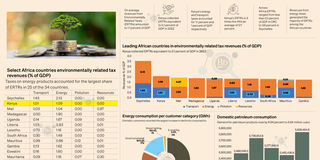
According to an annual revenue statistics review by the Organisation for Economic Co-operation and Development (OECD), Kenya collected ERTRs equivalent to 2.1 percent of GDP in 2023, split between transport taxes (1 percent) and energy taxes (1.1 percent).
Notably, no revenues were raised from pollution or natural resource taxes, placing Kenya in line with many African economies but behind several advanced markets.
Taxes on energy products accounted for the largest share of ERTRs in 25 of the 34 countries.
The data paints a stark picture of how environmental taxation is deployed as a fiscal tool, rather than a climate instrument in most African countries. While energy and transport levies boost revenue mobilisation, the lack of pollution taxes indicates limited use of price signals to discourage investment away from carbon-intensive activities.
Seychelles, at 3.5 percent of gross domestic product (GDP), is one of the few countries in Africa that recorded higher environmentally related tax ratios, largely from energy and transport levies.
By contrast, the OECD average stands at about 1.7 percent of GDP, with a more diversified mix that includes pollution taxes and emissions-related charges — instruments that remain largely absent across Africa.
The data points to untapped revenue potential as governments look to fund climate adaptation, infrastructure and energy transitions, without raising headline income or corporate tax rates.
As pressure mounts to align fiscal policy with climate commitments, Kenya’s next phase of green taxation may determine whether environmental levies evolve beyond revenue collection, into a broader tool for climate finance and behavioural change.