Time flies with great content! Renew in to keep enjoying all our premium content.
Prime
Kenya Power, Kenya Railways lead in hiring casuals
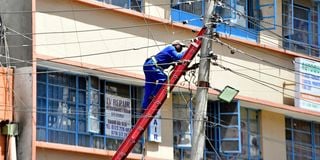
A Kenya Power technician at work. Nationally, more than nine in 10 (91 percent) homes had power supply and about four households were connected from the rural areas.
Kenya Power and the Kenya Railways Corporation are leading in employment of casual workers in government, collectively engaging 80.3 percent of all the 84,609 employed last year.
A survey by the Public Service Commission (PSC) shows that the two institutions continue to engage thousands of Kenyans as casuals in their repairs and rehabilitation works.
The law prohibits public institutions from engaging casuals but instead provides for contracted service providers.
The PSC survey found that nearly half (48.3 percent) of public institutions had hired a total of 84,609 casual workers.
“Casual employment is the engagement of an individual for a period not exceeding three months and paid on a daily basis.
“It was established that 259 (48.3 percent) institutions reported having engaged 15,127 casuals. However, the institutions submitted a list of 84,609 casual employees, which presented a variance of 69,482. The variance was from lists submitted by 80 of the 259 institutions,” the PSC survey found.
State corporations and semi-autonomous government agencies (Sagas) engaged the highest number of casuals at 76,925 (90.9 percent), followed by public universities with 4,807 (5.7 percent) and Technical and vocational Education Training institutes (Tvets) 1,367 (1.6 percent).
“The institutions that engaged the highest number of casuals were Kenya Power and Lightning Company, 53,436 (63.42 percent), followed by Kenya Railways Corporation, 14,465 (17.17 percent). As per the submitted lists, the two institutions accounted for 80.3 percent of the total number of casuals,” the survey notes.
PSC noted that the highest number of casuals or 32,210 were engaged in the rehabilitation and repairs services sector.
Some institutions, however, indicated that they had not engaged casuals but submitted lists of casual workers to the PSC, pointing to a possibility that the number of casual workers being employed in the public service could be even higher.
The institutions include South-Eastern Kenya University which had a list of 84 casuals despite stating that it had not employed workers under casual terms, Kisii National Polytechnic (15), Kenya Institute of Special Education (3) and National Council for Law Reporting (4).
The PSC advises public institutions “to comply with the judgement from the Employment and Labour Relations Court, which directs that public institutions use contracted service providers in the place of casuals when the need arises.”
The advice comes at a time when the commission charged with overseeing the welfare of workers in the public service notes that 62 institutions have reported paying 2,076 workers outside their payroll systems.
Payment of salaries outside the payroll system exposes institutions to the risk of loss of funds due to poor accountability for the spending.
“Of the officers paid outside payroll, 411 (19.8 percent) were accounted for in the staff bio-data, while 1,665 (80.2 percent) were not accounted for in the staff bio-data,” the PSC notes.
The Kenya Wildlife Service (KWS) led the list of institutions compensating workers outside the payroll by paying 853 workers outside the system, followed by Murang’a University of Science and Technology which paid 292 officers outside the system.
“Others were the Office of the Deputy President, with 107 (5.2 percent) officers, and South-Eastern Kenya University (SEKU), with 73 (3.5 percent) officers,” the PSC notes.