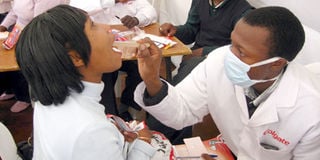
A dentist examines a patient. According to the Economic survey 2015, Kenya currently has only 1,090 registered dentists. PHOTO | FILE
Most dentists in Kenya are based in major urban towns, leaving only 20 per cent to serve the rest of the country’s rural population amidst a serious shortage of practitioners.
According to the Economic survey 2015, Kenya currently has 1,090 registered dentists, a slightly higher figure than 1,045 recorded in 2013.
However, this translates to one dentist for every 42,000 Kenyans, a ratio far below the World Health Organization's recommendation of 1:7,000 patients.
“We have a serious shortage of dentists in this country and the government should make deliberate efforts to ensure that we train these personnel to avoid overstretching the little we have for maximum services,” said Professor Jacob Kaimenyi, a periodontal dentist and Cabinet Secretary for Lands.
“The current dentist patient ratio in the country stands at 1:42,000 people while the best countries have 1:2,000. With almost every dentist being in major towns that leaves the rural folk with nobody to attend to them,” he added.
Professor Kaimenyi was speaking during a summit meeting in Nairobi addressing the state of oral health in east Africa.
He said that the government in 1984 had launched a training of a cadre of community oral health workers to bridge the gap of dentists and so far only 1,000 have been trained since.
Out of the 1,000, only 135 have been employed by the government.
“This means that the majority of them are either employed by the private sector or self-employed, thus very demotivating to young people who want to pursue a career in oral health,” he said.
Prof Kaimenyi said that like other professions, dentists also have specializations that come in quite handy.
Oral pathologists who study odontology or forensic dentistry can be used in identifying victims of accidents or crimes where the body has been destroyed beyond recognition such as fires, hence speeding up the process. However, Prof Kaimenyi says that the country has less than seven of them.
Unilever vice president for personal care, Debra Mallowah, said that the firm has partnered with Columbia University, University of Nairobi and the Kenya Dentist Association to create models of oral health that will inform national policy.
“All healthcare is key in an economy’s progression and preventive oral health is key. We want to reach over one million children in 3,000 schools in the country to scale them up and reinforce them in oral heath hygiene and tooth brushing,” said Ms Mallowah.
Unlock a world of exclusive content today!Unlock a world of exclusive content today!