Kenyans cut extra pension savings on higher NSSF deductions

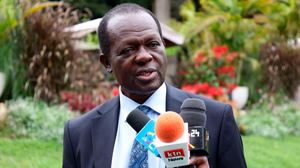
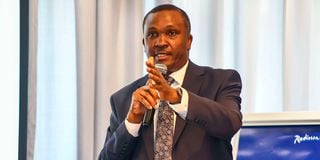
Retirement Benefits Authority CEO Charles Machira speaks during a past meeting at Radisson Blu Hotel, Nairobi Upper Hill on March 14, 2025.

Photo credit: File | Nation Media Group

Kenyans cut payments of additional voluntary contributions towards their employers’ pension schemes by nearly Sh1 billion in 2024 amid higher deductions to the National Social Security Fund (NSSF).

Data from the Retirement Benefits Authority (RBA) shows that members’ additional voluntary contributions fell by 47.2 percent or Sh906.7 million last year to Sh1.01 billion from Sh1.92 billion previously.
Employees channel an agreed value of their wages to employer occupational pension schemes, but are allowed by law to make higher deductions above the set threshold.

These additional voluntary contributions (AVC) have now shrunk amid higher mandatory deductions to the State-backed NSSF.

The industry regulator has attributed the drop in the voluntary top-ups to the load of higher NSSF contributions, which currently stand at a maximum of Sh4,320 for top earners.

Employees have been paying a higher NSSF contribution each year since February 2023, when the new NSSF Act 2013, was cleared by the courts for implementation for the first time.

“While normal contributions from both parties showed strong growth, additional voluntary contributions and medical fund contributions declined, suggesting a shift in focus towards mandatory contributions,” said the RBA.

The implementation saw the immediate growth in deductions from a flat Sh200 per month per employee to Sh1,080 in February 2023.

The rates subsequently doubled to a ceiling of Sh2,160 in February last year before doubling again in February 2025 to Sh4,320 per month.

The mandatory deductions are expected to grow again in February 2026 by 50 percent to a maximum of Sh6,480.

Employees earning Sh30,000 today part with Sh1,800 per month as NSSF deductions, while a Kenyan grossing Sh50,000 a month is parting with Sh3,000.

Kenyans earning Sh80,000and above in gross salaries are paying the maximum Sh4,320 to the NSSF.

Employers who match the contributions for workers are required to send a mandatory Sh480 of top earners’ salaries to the NSSF, while the balance of Sh3,840 can be paid to the employer’s occupational scheme or umbrella scheme.

The employer must, however, apply to contract out of the NSSF and obtain approval from the RBA.

Higher NSSF contributions have resulted in reduced disposable incomes for workers, resulting in lower additional voluntary contributions.

Disposable incomes have been further affected by a softer economy and additional mandatory deductions such as the 1.5 percent housing levy.

Wages after inflation fell for a fifth consecutive year in 2024 as the stagnation of income extended amid a steady rise in living costs.
The real wages declined by 0.3 percent as per data from the Kenya National Bureau of Statistics (KNBS), as employers remained reluctant to offer big pay rises.

The average monthly real pay has fallen from Sh62,656 in 2020 to Sh55,451 last year, which translates to an erosion of Sh6,805.
Employers previously warned that it would take longer to see pay rises as firms fret over business uncertainties, even after economic growth rebounded from pandemic lows.

The government began collecting a matched 1.5 percent of gross worker salaries in June 2023 as contributions to the affordable housing fund (AHF), further cutting worker wages.

In October of the same year, the Kenya Kwanza administration overhauled the National Hospital Insurance Fund (NHIF), renaming it the Social Health Insurance Fund (SHIF), which demands that employees part with 2.75 percent of gross salaries as contributions to the kitty.

The value of the pension industry has, however, not been dented by the loss of additional voluntary contributions, as higher mandatory contributions more than compensate for the drop.

The total pension industry fund value rose at its fastest rate in more than a decade (21.18 percent) to Sh2.23 trillion as of December 2024 from Sh1.84 trillion previously, according to the RBA.

Membership and coverage also improved to 26.57 percent of the working-age population, or 7.53 million workers.

6.96 million of the members are covered by the mandatory NSSF contributions, while a further 563,790 workers are in other schemes.

3.74 million of the members were counted as active, 41,046 were pensioners, while 3.57 million were deferred.

“This growth was driven by improved public sensitization, targeted outreach efforts, and policy measures, including the implementation of the NSSF Act, 2013, which are aimed at encouraging participation,” RBA chief executive officer Charles Machira said.

“However, a significant proportion of workers in the informal sector remain outside the pension system, highlighting the need for innovative and flexible pension solutions.”

PAYE Tax Calculator

Note: The results are not exact but very close to the actual.