Time flies with great content! Renew in to keep enjoying all our premium content.
Prime
Kenyans support SRC in salary row
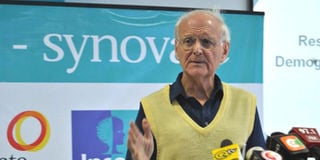
Ipsos Synovate lead researcher Tom Wolf briefs journalists in Nairobi on May 15, 3013. Photo/ANTHONY OMUYA
An overwhelming majority of Kenyans support the Salaries and Remuneration Commission (SRC) in its dispute with MPs over salaries, a new survey has revealed.
The Ipsos Synovate opinion poll released on Thursday shows that 86 per cent of Kenyans want the commission to continue with its work against just eight per cent who want the Sarah Serem-led commission disbanded.
The poll funded by Ipsos Synovate was carried out between May 10-11 through telephone interviews, with a sample size of 1,660 adult respondents in both rural and urban areas covering 43 counties. It had a margin of error of +/-2.41 with a confidence level of 95 per cent.
“Most Kenyans who support the ‘reduction’ feel that it is unfair for the legislators to ask for more money at a time when many Kenyans are suffering.
This is the reason given by 59 per cent of those who support the review. Another 22 per cent stated that the government cannot afford to pay more as it will increase an already expanding public debt,” said Synovate lead researcher Tom Wolf.
The poll found that 63 per cent of the respondents were aware that the nature of the dispute between MPs and SRC involves higher salary demand, given the high publicity the issue has received. Some 88 per cent of this category supports the reduction of MP salaries.
He noted 10 per cent of the respondents backing SRC felt that the MPs were aware of the reduced salary before contesting and should, therefore, not raise the issue now.
Under the new pay structure, an MP is entitled to a basic salary of Sh532,500, down from the Sh851,000 that their counterparts in the 10th P arliament earned.
Among the 11 per cent of the respondents aware of the salary dispute and backing the MPs’ demand, close to half (48 per cent) said that it was unfair to reduce the salaries when previous MPs were making more.
23 per cent of the MPs backers said that any ‘reduction’ in MPs pay is unfair unless the same is done to all senior public officials. A further 12 per cent said the impasse on the salaries is delaying parliamentary business, with nine per cent of the opinion that MPs need the extra money to assist needy constituents.
Interestingly, 91 per cent of all respondents stated that they have never received personal financial assistance from an MP. One of the reasons MPs have advanced in their quest for more money is their constituents’ demand for handouts.
Of the 150 out of 1,660 respondents who said they have received financial assistance from MPs, 86 per cent were still of the opinion that the SRC is doing the right thing in reducing MPs salaries.
Similarly, 88 per cent of those who have never received financial assistance from MPs support the SRC.
SRC chairperson Sarah Serem came out fighting on Monday to defend her team’s action on the MPs pay, saying that it came up with the figure after studying pay structures in 10 economies, namely the five East African Community states, the US, UK, Canada, Ghana and South Africa.
Parliament in the meantime has already factored in the higher pay in its Sh24.5 billion 2013/14 budget estimates tabled by PSC vice chairman Adan Keynan last Thursday.
It contains Sh10 billion to cater for salaries and other allowances anticipating a return to the pay rates enjoyed by the previous Parliament. The MPs have also set in motion a bid to remove members of the SRC through a petition tabled by Igembe South MP Mithika Linturi.
The jist of MPs’ arguments is that by publishing the Kenya Gazette notice of March 1 on their salaries and repealing provisions of the National Assembly Remuneration Act, SRC was in breach of the law.
They argue that SRC did not arrive at the Sh532,500 after an evaluation of their jobs but by simple arithmetic.
Mrs Serem on Monday however ruled out immediate review of the formula used to arrive at the MP salaries, saying the state stands to save Sh1.4 billion per year, and also see a reduction in the pay disparity between the top and bottom earners.
She described the use of 50.4 per cent of the projected 2013/14 revenue collection (Sh458 billion) to pay wages of 700,000 public servants as unsustainable if the government is to achieve and sustain annual growth of between seven and 10 per cent.