Time flies with great content! Renew in to keep enjoying all our premium content.
Prime
Maseno varsity medical students face tall order even before graduation
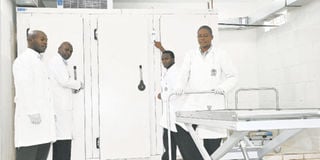
Maseno University School of Medicine students at the mortuary where cadavers are stored. The students are among the first batch admitted to the university. Jacob Owiti
One night medical personnel at Maseno University hospital were confronted with a potentially life threatening medical emergency.
A student at the university had been involved in a fight and had severe head injuries and showed signs of brain trauma.
“There was no one at the referral hospital in Kisumu who could handle the case so I had to place a call to the Moi Teaching and Referral Hospital in Eldoret and immediately transfer the student,” recalls Prof Dominic Makawiti, the vice chancellor.
Luckily the patient arrived at the hospital in good time and surgeons managed to operate on his head and clean up the blood that was leaking into the patient’s brain.
The incident brought to light the reality that is the lack of specialised medical personnel in Nyanza and western Kenya. The region, which is home to over 10 million Kenyans, has no cardiothoracic surgeon, has only one nephrologist, three surgeons and only three obstetric gynaecologists.
Even more worrying is the fact that Nyanza and western Kenya’s predominantly rural population bears the burden of preventable diseases like malaria, tuberculosis, HIV/Aids and the consequent maternal and infant mortality cases.
The region’s largest healthcare facility is unable to handle some referral cases owing to lack of specialised personnel and equipment, forcing health workers to transfer patients to the Moi Teaching and Referral Hospital in Eldoret or the numerous referral centres in Nairobi.
This compels patients to travel long distances in search of specialised healthcare. On top of the pain of illness, patients face physical and financial hurdles, with many having to relocate during the entire duration of their treatment for periods ranging from a few months to years.
It therefore came as a relief at the beginning of the year when Maseno University’s School of Medicine opened its doors to its first batch of 58 students.
According to Prof. Makawiti, the region’s first school of medicine will go a long way in uplifting the standards of healthcare in Western Kenya and Nyanza provinces.
“There is a need to grow and nurture medical practitioners and even specialised personnel to serve the needs of this region,” he said. “We believe that the medical school comes at an opportune time to serve this need.”
The university’s school of medicine offers a Bachelor of Medicine and Bachelor of Surgery and a Bachelor of Science in Nursing.
Prof Wilson Odero, the dean at the School of Medicine, is well aware of the expectations that the region has for the new training facility and the challenges that lie in wait.
“Our purpose is to improve the quality and quantity of doctors in this region,” he said. “The teaching staff is also offering consulting services for the medical facilities in the region and the students will also be holding medical camps in the surrounding community as part of their community service once the time is right”
However the establishment of a school of medicine at Maseno University has far reaching impacts that go beyond the region’s academic and medical needs.
The first medical school in the country was established at the University of Nairobi in 1967. The second school of medicine admitted its first batch of students in 1990, more than 20 years later at the Moi University.
Since then, other universities have established schools and colleges offering degrees in medicine. These include Kenyatta University, Egerton University and Aga Khan University among others.
Data from the Kenya National Bureau of Statistics indicates that from 2006 to 2010, the number of medical practitioners in the country has been growing at an average rate of 5 per cent. A small figure compared to the growing population in the country which leapt by 10 million between 1999 and 2009 to stand at 40 million.
According to the World Health Organisation (WHO), the patient to physician ratio in the country stands at 1 to 10,000. This is less that the African region ratio of 2: 10,000 and far below the WHO recommended 1 physician per 1000 patients.
In addition to this, poor remuneration and working conditions have seen the practice of medicine in the country become one of the identifiers of brain drain.
The training of future medical personnel therefore ranks high on the priority list for stakeholders in the medical field even as more specialised practitioners leave the country for greener pastures.
Michael Owiti is the only nephrologist south of Nakuru. The kidney specialist covers part of the North Rift, Nyanza and western Kenya provinces.
Because he is the only one in his field, Dr Owiti shuffles between teaching at the Moi and Maseno Universities schools of medicine.
At the same time, he remains actively on call for special consult in the two largest referral hospitals in the region as well as the largest private hospital in Kisumu.
A tasking burden and one that Dr Owiti says should be spread across more than one pair of hands hence the urgent need for a medical training facility.
“This facility has been long in coming because the region has largely been left out despite having produced some of the finest brains in medicine in the country”, he said.
“We need to facilitate more people in the region to develop interest in medicine and by doing so we will be able to improve our capacity to provide affordable health-care.”
Dr Owiti further states that a medical training facility is essential in the generation of data to help develop health policies specific to the region’s health-care needs.
“Before we can hope to bring down the mortality rate from the region’s preventable disease burden, there is a need to develop fresh data on the said diseases”, he said.
“The surest form of data collection is when medicine students and faculty members conduct studies in their vicinity and their findings get published on medical journals both locally and internationally.
The information is thus made available to anyone ranging from fellow scholars who want to advance the research to donors who have a cause against a specific disease.”
Dr Owiti states that part of the reason the region has maintained its high preventable disease burden is the fact that there has been no training facility dedicated to search for and provide community specific solutions for the region.
“The fact that we did not have a medical training facility in the region played to our disadvantage because we did not have many researchers conducting their studies on the ground and therefore no data coming out and this becomes difficult to state our case.”
Dr Aggrey Akula, the head physician at the Kisumu District Hospital agrees that there is a need to increase the number of specialised medical personnel in the region.
However, the hospital administrator states that of more importance is the need to build up the numbers of medical personnel in general practice to augment the current shortage experienced not only in Nyanza and Western Kenya, but in the entire country.
“Yes there is a need to train highly specialised medical personnel and build up the numbers of the same. However of primary importance is the low number of physicians and this needs to be addressed because they handle the bulk of the medical cases.” “We can have three or four highly specialised surgeons in specific areas of medicine for referral cases but first we need to train general physicians.
Dr Akula further states that there is a need to encourage more doctors to set up private practice in the region especially in areas where public health facilities are lacking.
“When one has been trained in a particular region for six years they tend to assimilate into the surrounding environment. That is one of the reasons you find many doctors setting up practices in Nairobi because they come out of medical schools in Nairobi, Kenyatta and Aga Khan Universities and find it easier to settle in the city.”
“By having a medical school in the region, it will be easy for students once they graduate to continue operating in the region seamlessly and in that way boost the numbers of health workers.”
However, setting up a new medical training facility from scratch does not come cheap. There are stringent requirements set by the Kenya Medical and Dentistry Professional body and the Commission for Higher Education in order to receive accreditation. The institution must have fully equipped labs, an anatomy block, teaching faculty for each programme, a morgue to preserve cadavers used in teaching and above all an affiliation with a teaching hospital for medical training and teaching practicals.
The initial infrastructure costs alone stand in the hundreds of millions and Maseno University has formed a working MoU with the Nyanza General Referral Hospital to use its facilities for teaching.
Aside from the capital expenditure there are huge running costs, the bulk of which go to servicing large utility bills, expensive laboratory equipment and attracting and retaining academic staff.
The latter is of special concern because medical practitioners are few and lecturers of medicine even fewer. Most lecturers teach in at least two institutions and offer consulting services in as many health centres.
Dr Kennedy Onyango is one of the three obstetrician gynecologists in Nyanza and also a lecturer at the new school of medicine and he says that the dwindling number of medical staff can be squarely blamed on poor remuneration and brain drain.
As a requirement for the university by the medical and dentistry board there needs to be some specialists and sub-specialists which we do not have.
“We are however optimistic that by the time the students are in their fifth and sixth year when they need these specialists the most, we are going to have them in place.”
Dr Kennedy Onyango further states that the changing face of modern medicine has necessitated a re-thinking on research and policy formulation in the medical field.
“Modern medicine is changing. The adoption and evolution of new technology in everyday life has also seen a similar adoption rate in medicine.
“Nowadays we have equipment that do the work faster and more precisely and medicine students need to be trained in the use of these equipment.”