Time flies with great content! Renew in to keep enjoying all our premium content.
Prime
Salaries team plans to harmonise allowances
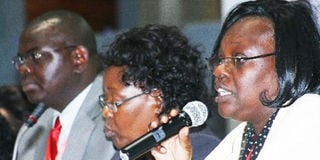
SRC official Elizabeth Owuor speaks at a public forum on the proposed remuneration structure for State officers. Photo/Jennifer Muiruri
The purge on the public wage bill has shifted to the myriad allowances drawn by State officers and civil servants.
The Salaries and Remuneration Commission (SRC) said it would streamline the allowances, which came under sharp focus on Thursday during the first public hearing on proposed salaries for State officers.
“The allowances are the most abused by State officers and others in the public service. Most of them create needless trips out of office just to make money and are never accountable for the actions. This leakage must be addressed exhaustively,” Okweh Chemba, a lawyer, told the hearing organised by the SRC.
The allowances most abused by public officials are those not listed on their payroll, such as travel perks. Many officers rely on the allowances other than their salaries.
SRC vice chairman Daniel Ogutu said the commission would shift to harmonisation of allowances to tame the expenditure on wages.
“We shall do a comprehensive review of the allowances because they have emerged as one of the biggest causes of revenue leakage. It is one of the critical issues we have to address if we are to meet our objective,” Mr Ogutu said.
He said the commission would also develop a national salaries and employment policy to guide the remuneration of State and public officers.
“We want to have everything legally captured in a policy so that we have a referral point to guide any review processes,” he said.
The country currently has no salary and employment policy, leaving room for massive discrepancies in the way officers are hired and compensated.
Since independence the government has tackled the issue of remuneration through ad hoc task forces and Collective Bargaining Agreements (CBA), which are hijacked by partisan interests.
The Constitution seeks to redress the situation by having all activities anchored on a legal framework under the SRC.
Mr Ogutu said pay structures for both State and public officers would be gazetted to ensure they are fully implemented.
“By having the remuneration structures gazetted we shall have addressed the fears of non-implementation because it will be law,” he said.
On Tuesday the SRC released recommended pay structures for 3,670 State officers which it said would directly save Sh500 million and about Sh1.7 billion when all perks, including allowances not factored in the payroll, are revised.
MPs, widely unpopular for awarding themselves hefty salaries and allowances in recent years, have been dealt a blow after the SRC recommended their gross salaries be cut to Sh740,927 from the current Sh851,200.
Most participants at the public hearing in Nairobi on Thursday, however, called for deeper cuts to the salaries of the State officers.
“The wage bill should be restricted to a maximum 25 per cent of the national revenue. We cannot afford going beyond this level,” Julius Okara from the Kenya Private Sector Alliance said.
Statistics by SRC showed that the estimated public sector wage bill for 2012/13 has hit 457.5 billion, a whopping 30.2 per cent of the total national budget of Sh1.51 trillion.
The central government wage bill took about 35 per cent of the total government revenue while servicing of debt took up 17.2 per cent over the last nine years, leaving only 48 per cent for other operations.