State operating costs surge, breach Treasury target

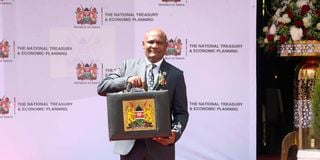
National Treasury Cabinet Secretary John Mbadi displays the Budget briefcase ahead of unveiling the government spending plan for the financial year 2025/2026 in Parliament on June 12, 2025.

Photo credit: File I Nation Media Group

Government spending on day-to-day expenses such as office supplies, transportation, fuel, travel and repairs in the first quarter of the current financial year ending June 2026, rose for the first time in three years, signaling easing of deep cuts in operational costs.

The National Treasury has disclosed in the latest quarterly budgetary report that operations and maintenance (O&M) expenditure for the July to September 2025 period climbed 41.34 percent to Sh320.90 billion.
The jump from Sh227.05 billion in the same quarter of the previous year marked the first early-year expansion in the cost of running public offices and maintaining State assets since President William Ruto took office, pledging deep austerity on non-essential supplies.

The spending further breached Treasury’s Sh267.08 billion quarterly O&M target by Sh53.82 billion, suggesting State ministries, departments and agencies have started catching up on deferred operational needs after two years of compressed budgets. 

O&M spending covers a wide range of day-to-day costs, including office supplies, domestic and foreign travel, vehicle maintenance, fuel and lubrication costs, hospitality, repairs to public buildings and assets, telecommunications bills and other utilities such as electricity and water.

The rebound bucks the trend in the preceding two financial years. In the first quarter of last financial year ended June 2025, O&M spending dropped to Sh227.05 billion from Sh241.25 billion in the comparable quarter of financial year 2023/24 and Sh260.67 billion in 2022/23.

The rebound signals an easing of the deep cuts the administration imposed after the withdrawal of the Finance Bill 2024, which created a Sh344.3 billion hole in the national budget.

Hard-pressed citizens battling high cost of living amidst stagnant earnings resisted increased taxation, forcing the government into expenditure cuts of Sh170 billion and increased borrowing to make up for revenue shortfalls.

Operational expenses became a soft target, with sweeping reductions enforced across ministries, departments and agencies as the government raced to stabilise public finances during a period of youth-led nationwide anti-tax demonstrations.

“What we ended up with was more like a 50-50 [situation] where we had to take more debt and reduce expenditure by almost Sh170 billion. This is a space where most government institutions had never been because… they did not get what they wanted,” Treasury Principal Secretary Chris Kiptoo said on May 14 during an interview on NTV.

The early-financial year numbers indicate that after two years of austerity and restrained spending on non-essential operational needs, public offices have swung back into more active spending to cover their day-to-day functioning at a pace that could test the government’s commitment to tightening its purse strings.

The cuts that followed the collapse of the tax bill at the start of last fiscal year included removal of budgets for refurbishments and partitioning of government offices, purchase of new vehicles except for security agencies, halving of renovation expenditure and reduction of budgets for travel and hospitality.

Others were suspension of purchase of new cars, whose cost can top Sh30 million per unit, for the first six months, halving government advisers and ensuring enforcement of retirement of public servants aged 60.

Dr Ruto had also scrapped budgets for offices of first and second ladies as well as confidential budgets for State House and all public offices as part of expenditure cuts following the collapse of a plan for new and higher taxes.

The anti-government protests-induced austerity was in addition to earlier announced removal of non-essential expenditures such as printing, advertising, travel, communication supplies and services, training, hospitality, furniture, refurbishment and vehicle purchase as well as research and feasibility studies for public offices.

PAYE Tax Calculator

Note: The results are not exact but very close to the actual.