Taxes on the gains or profits by non-resident ship owners or charterers are now deducted at source by their customers in Kenya in a key shift by the Treasury aimed at sealing revenue leaks and boosting cash flow.
The Finance Act 2025 has amended the Income Tax Act and shifted the burden of deducting tax on the gains and profits by non-resident ship owners to their customers in Kenya, who rented their services for a specific period or voyage.
“Section 35 of the Income Tax is amended…. by inserting the following new paragraph immediately after paragraph (t)—(u) gains or profits which are chargeable to tax under Section 9(1) derived from the business of a ship owner or charterer,” states the Finance Act 2025.
Previously, non-resident ship owners or charterers were required to account for and pay tax in Kenya at a rate of 2.5 percent of the gross amounts received from the embankment of cargo in Kenya—the process of loading cargo onto a vessel for transportation to export markets.
However, there were concerns that some non-resident shippers were likely to underreport their income or avoid filing tax returns altogether.
Under the new arrangement, the Kenya-based customers engaging the non-resident ship owners are required to impose a 2.5 percent withholding tax (WHT) on the gross amount payable, which is deducted upfront.
WHT is a retention tax, whereby the party paying for services rendered is responsible for deducting tax at source from payments and remitting the deducted tax to the Kenya Revenue Authority (KRA) on or before the 20th of the following month.
Imports into Kenya and transshipment cargo are exempt from the WHT rule. The rate of WHT also varies, especially for nations with double-tax treaties with Kenya.
Container shipping company, Maersk, said that this amendment imposes a WHT obligation on Kenyan customers making freight (shipping) payments for exports from the country, as well as and detention and demurrage (DnD) charges to non-resident shipping companies.
DnD charges are fees imposed by shipping lines or terminal operators when containers are held beyond the agreed-upon free time.
“Therefore, under the new law: Customers are required to withhold tax when making payments to Maersk A/S, irrespective of the bank account used; and No WHT should be withheld against Maersk Kenya Ltd, as it is not the recipient of the shipping income nor the service provider,” the shipping line said in a July 10, 2025 note to its customers.
WHT is popularly used in Kenya because it boosts government cash flows as an advance tax payment. It also allows income derived from the country to be taxed automatically, limiting the potential for evasion.
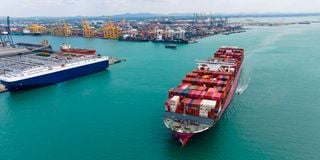
Kenya is a major hub for non-resident ship owners and charterers, who use the Port of Mombasa to service the domestic and regional supply chains.
The Mombasa port, which is the largest in East Africa and the region's trade gateway. It handles the import of fuel and consumer goods, and the export of tea and coffee from Kenya and its landlocked neighbours, such as Uganda, Rwanda, the Democratic Republic of Congo and South Sudan.
Latest data from the Kenya Ports Authority (KPA) shows that the volume of cargo handled through the Mombasa port grew by 8.1 percent in the first six months of 2025, boosted by upgrades to cargo-handling infrastructure, which improved the turnaround times for ships.
The port handled 21.3 million tonnes of cargo between January and June 2025, up from 19.7 million tonnes in a similar period in 2024, despite supply chain hiccups, including disruptive attacks by the Houthis rebel group on the Red Sea route.
The port handled 1,012,949 twenty-foot equivalent units (TEUs) of container traffic, up from 948,983 TEUs in a similar period of the previous year— a growth of 6.7 percent.
KPA said that both imports and exports experienced significant growth, with imports increasing by 48,793 TEUs (13.4 percent) and exports rising by 50,572 TEUs (14.4 percent).