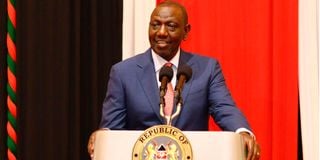
Eight Kenyans have sued President William Ruto's government for what they termed as "wage slavery" caused by too many taxes and levies introduced "with reckless abandon".
The petitioners, who approached the High Court under a certificate of urgency, want the court to cap the taxes and levies that can be imposed on an individual at 20 percent and 30 percent for corporate bodies.
"In its classical meaning, any person whose labours can only afford them the basic necessities of food, clothing and shelter is considered a slave or a wage slave. Over the last one year, many Kenyans have fallen into the wage slave bracket despite the fact that Article 30 of the Constitution absolutely prohibits slavery in Kenya," they said in the petition.
“The petitioners contend that excessive taxation is the main reason why wage slavery is becoming institutionalised in Kenya as the incumbent government, supported by its rubber-stamp National Assembly, enacts and enforces new laws to justify deduction of taxes and levies from the income of workers and business owners.”
Since July this year, the Kenya Kwanza administration has introduced new tax policies, including an increase in monthly salaries from a maximum of 30 percent to 35 percent; a new 1.5 percent housing tax, with an equivalent amount paid by the employer; a 2.75 percent hospital insurance fund levy; and a 3 percent turnover (gross sales) tax on small businesses.
There has also been a doubling of fuel taxes to 16 percent and an increase in corporate tax from 25 percent to 30 percent.
Already, the Federation of Kenya Employees (FKE) said last month that a preliminary survey shows that 70,000 Kenyans have lost their jobs in the past year, and more are at risk of losing their jobs as employers consider further job cuts.
The lobby blamed the implementation of the controversial Finance Act, 2023 as the genesis of the current woes, saying that if the current state of affairs continues, 40 percent of employers will be left with no option but to send their workers home.
They want their case to be heard by a bench of at least five judges.
The eight petitioners are Fanya Mambo Kinuthia, Kenneth Njagi Njiru, Peter Koira, Charles Mabiru, Ishmael Muriithi Ngung’ira, Jackline Wanjiru Mwangi, Vincent Lempaa Suyianka, and Mount Kenya Jurists Association.
They have sued Attorney-General Justin Muturi, Treasury Cabinet Secretary Njuguna Ndung’u, the National Assembly, the Senate and the Kenya Revenue Authority.
They have also claimed that the Affordable Housing Bill, 2023 is grossly unconstitutional as it effectively transfers the responsibility of providing housing from the state to the tax-paying citizens to benefit another class of hitherto unknown citizens, in the context of Article 43 of the Constitution.
They said there is no legal framework for the Affordable Housing Schemes and argued that the programme seeks to build high-rise ghettos across Kenya.