Wildlife group asks Kenya to strengthen anti-poaching laws

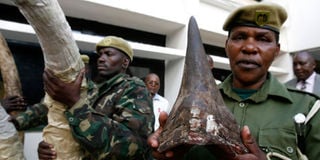
Kenya Wildlife Services (KWS) rangers display elephant tusks and rhino horns intercepted at the Jomo Kenyatta International Airport, Nairobi in July 2009. PHOTO | FILE

Weak laws have exposed Kenya’s game parks to poaching even as government officials lead global campaigns to end the menace.

The Convention on International Trade in Endangered Species of Wild Fauna and Flora (Cites) says Kenya is among 17 countries that need to urgently strengthen their laws to effectively combat illegal trade in wildlife.
Others named alongside Kenya are Algeria, Belize, Bolivia, Comoros, Djibouti, Guinea-Bissau, Kazakhstan, Liberia, Mauritania and Mozambique. Pakistan, Paraguay, Rwanda, Somalia, Tanzania and Venezuela were also identified to have weak legislation.

“Most had made progress to adopt appropriate legislation before the upcoming meeting of the Conference of the parties in September this year,” Cites said in a statement.

Poaching remains a major concerns especially in eastern Africa where hundreds of elephants continue to be killed for their ivory.

A global ivory trade ban went into effect in 1989 after Africa’s elephant population plunged from 1.2 million to 600,000. But illegal trade continues, with strong demand in China, other Asian states and places like the United States.

A United Nations resolution last year urged states to “take decisive steps at the national level to prevent, combat and eradicate the illegal trade in wildlife, on both the supply and demand sides, including by strengthening the legislation necessary for the prevention, investigation and prosecution.”

An estimated 100,000 African elephants were killed by poachers between 2010 and 2012, according to a 2014 study by the National Academy of Sciences.

Much of the demand for ivory comes from Asia. In China, a growing affluent class has increasingly sought ivory as an ornamental item.

Some experts have reported that speculators in eastern Asia are stockpiling raw ivory, hoping it will fetch higher prices in the future.

Cites urged nations with elephant populations to report comprehensive and accurate figures to the Monitoring Illegal Killing of Elephants (Mike) and Elephant Trade Information System (ETIS) programmes to reinforce the fight against illegal trade in wildlife.

“Estimating elephant population numbers is complex, however, due partly to their wide-ranging territories,” it stated.

China last year slapped a one-year ban on African ivory hunting trophy imports, amid concern by conservationists who say the Asian country’s rising appetite for contraband ivory imports has triggered a surge in poaching in Africa.

PAYE Tax Calculator

Note: The results are not exact but very close to the actual.