Time flies with great content! Renew in to keep enjoying all our premium content.
Prime
All about romancing the stone
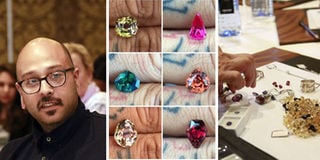
Precious stone cutter Jean-Noel Soni during the Gem Affair event themed: "Romancing the Stone" at the Villa Rosa Kempinski last week (left), and precious and semi-precious stones on display (right). PHOTOS | DIANA NGILA | COURTESY
Joel-Noel Soni is a world-renowned gem cutter, who has been in the business for the last five years. So good is his work that people from all walks of life ranging from jewellers to collectors seek his expertise.
The California-based gem-cutter made his first trip to Kenya last week on the invitation of Diana Atieno of Porini Gems.
The humble and seemingly happy 32-year-old was the centre of attention during the “Romancing the stones” one day talk that happened last Friday, at the Villa Rosa Kempinski. BDLife had a candid conversation with him.
-------------------------------------------
What do you do?
I am a self-taught gem cutter. Over the past couple of years, I have developed techniques that I have not seen in the industry yet. I work with each stone individually rather than trying to fit them to commercial proportions. And I have fun as I travel doing it. I go to countries to source for rough stones, I give lectures to colleagues across the United States and in Europe. Sincerely, I’m not really sure of what I’m doing, I am trying to figure it out (smiles).
What are some of these techniques that you have developed?
Putting a clean polish on the stone is one thing. People can come from different paths to arrive at the same place. I have formulated different proportional foundations to build upon different shapes that the commercial market has not yet figured out. Mindfulness for the stone rather than mindfulness for the shape is what I would say.
What sort of shapes do you cut?
I have done over 600 shapes so far. Let me show you (scrolls through Top Notch Faceting Facebook page). Every single stone is different. I do something different with each stone. I really don’t know what to call the shapes. But it’s more about the stone, the focus should be on the gem and not the shape. No two are alike, every gem is unique.
So every gemstone you cut is unique..
When you have natural growth, no two are alike. It is such a scarce commodity and for me to fit one into a specific design, I have to purposely butcher the stone to get it to fit, and that is crazy. I mean take sapphire, for instance, it takes five million tonnes of dirt to be moved to get to produce all good qualities of sapphire, and only five of them (pieces) will be clean enough to cut gemstones. And if I take one of them and butcher 80 per cent to make it into a specific shape, I mean that is crazy. I work around each rough stone (gemstone).
Which countries do you source the gemstones from?
In Africa, mainly from Nigeria, Kenya, Tanzania, Mozambique and Malawi. There is small mining going on everywhere but the markets are concentrated in Kenya and Tanzania. This part (Eastern Africa) is wealthy in gems. In Kenya and Tanzania, you will find sapphires, aqua marine gold, tourmaline, garnets, zircon and Tanzanite. I think Kenya has diamonds too but I know a few can be found in Tanzania.
Your clients come from all over the world, how do you manage to do business globally?
Over the last couple of years, I have cultivated a business that is very direct. If I am emailing somebody, I require that we at least talk on the phone. If I can I meet them in person, the better. That is the way I like doing business. If I am travelling, I tell them to wait till I am in their area. If we cannot meet then we will stick to emailing.
But I like to know the clients that I’m working with. It took me a while to cultivate that; I was slow at first but people now understand the nature of my business and how I like doing it.
Ever thought of making complete jewellery?
There is so much involved in these practices, like polishing and casting. I will just stick to cutting. My clients are mainly jewellers from all over the world. I have cut over 600 stones and those are 600 different people I have worked with. They range from collectors to people getting engaged.
What determines the cost of a gemstone?
The rarity of the stone. There is plenty of Tanzanite; there is lot of it, you see it everywhere. Good sapphires are rare and so the price of sapphire is way higher. To understand the scarcity of the stone, you really have to be in business to see what is happening and what is moving around. The colour, clarity and size also determines the cost of a finished gemstone.
So, when the jewellers come to you, do they come with specific demands or do they wait to be wowed?
It depends on what the clients are looking for. But most of the time, they come asking for what their clients want. Like the kind of shape and colour they want.
Instead of buying things like houses and cars, I buy rough stones. I have an extensive collection of stones at home that I have not yet cut. So when someone calls asking for a green stone, I say I have ‘these’ as an option.
What determines the number of facets? The gem on average - a standard round cut stones should have about 50 to 70 facets and that is a lot. On average, the stones I cut have 20 to 40 facets, I try to stay out of the way of the crystal so that it shows itself. You put too many facets and end up with too much sparkle - something they developed for the diamond market. To me, there is nothing really attractive about it.
How many pieces can you cut in a day?
I try not to stress myself out. Small sizes take me like four hours while bigger ones take longer. The longest it can take to polish it is eight hours.
When you say that you are self-taught, how did you learn, through the internet?
There’s no information on the internet about gemstone cutting. I found somebody who was selling the equipment (faceting machines), I bought them. Then I got a book that was written in the 60’s by a family in Texas. It is like a book written by a husband and wife that were giving classes in the early 60’s. They wrote the book which was pretty much practical lessons with the machine, I started using it and figured it out and here I am.
How do you describe yourself?
I don’t know what I am doing (laughs out loud.) All I is that I’m having fun. I am more in the business of people than of stones, if that makes sense. I really enjoy the interaction because interaction is unbiased on the borders. I can sit with the guys in Nigeria and it feels like I’m sitting down with stone guys in New York. The integrity and the etiquette of the business is quite the same, something that I really enjoy.
What type of people do you like working with?
People are so complicated, the Sri Lankans are soft-spoken people but are very tricky, you have to be very careful. Nigerians are very loud and aggressive but very good people. I love everybody the same and hate them the same.(laughs long and hard.)
About the tattoos, do you think they affect your business?
In the US, when am walking in some streets, people will tend to hold onto to their bags a little tighter because they have already judged me by my tattoos. But generally when I meet somebody and they can’t seem to see past the tattoos, that relationship does not go beyond a handshake.
Africa is interesting, people are more relaxed when it comes to things like tattoos. I remember there is this time I visited Nigeria and one of the guys I met asked me if I am a rapper. That was really funny and cool .
Do you heat or add colour to the stones?
I stay away from ‘treating’ a gemstone to change its colour. I like to think of myself as being in the business of gems. A true gem stone is something untouched by man. If you can take something and change it, that is not a gem.
About the middlemen, do they make business hard for you guys?
There is a place for them in this business. I mean they are ones willing to go to the DRC when everyone else doesn’t want to go there. Foreign brokers coming into Kenya is what I think is not alright. They buy the gemstones at a very cheap price and sell them in foreign countries expensively keeping all the profits to themselves. It is not right.
So what were you doing before you became a highly sought-after gem cutter?
I was a jack of all trades and a master of none (laughs). I used to do a bunch of things. I grew up in a tattoo shop. I used to teach mathematics in Philadelphia, I later worked for two museums as a museum researcher in Philadelphia. I also did surgical procedures for animal hospitals and zoos. I don’t know, I can’t keep still, the stones keep me still.
Does that mean you are not going to move away from gem cutting?
I can’t imagine myself doing anything else.
You enjoy doing it?
I love the people. I love the interaction with different cultures. Negotiating over something that doesn’t have a set value with somebody from a different culture is a very interesting thing.
You learn something new every time. People in the US have a problem with negotiating they stress out when doing it. When I’m negotiating, I think of it like if I say something straight to your face and it makes you uncomfortable, it helps us to get to know each other.
And in the gem stone business, the most important thing is our relationship. And the only way to truly get to know somebody is to stress them out and watch how they react. For me, that the reason for negotiating is to figure them out. It is not about the value or price, it is to figure each other out.
Earlier during the talk I heard you say that you are married?
Yes and a father to a four-year-old. His name is Henry.
How is parenting?
It gets better with time. I remember when Henry was small. I grew up as an only child and until him, I had never watch a child grow from day one. Seeing him grow, I remember saying that I cannot wait for the day he tells me what he wants. And now when he starts talking, I can’t wait for him to shut up. (bursts out laughing).
Is he that loud?
No, he just talks a lot. Parenting is amazing. You get to relive your childhood through a child. They remind you of the excitement that you enjoyed when you were a child.
Unlock a world of exclusive content today!Unlock a world of exclusive content today!