From its very first frame, The People Shall, a film that documents a year-long chronicle of Kenya's youth-led protest, resists the polished detachment of traditional documentaries. Instead, it is brimming with candour and desperation.
The storyteller is Nick Wambugu, best known for his work in fiction and thriller genres. But here, he makes a sharp departure, driven by a vision much bigger than cinema, giving the film its emotional core and narrative sense.

Filming began in June 2024, the initial day of the demonstrations and laboured incessantly for an entire year. No scripted forethought, no tidy scheme, just faith in the power of being present.
They recorded each day of the protests, each moment of fear and triumph at risk to themselves. “We did not know what we were doing, but we just knew, let's go with our cameras on the streets," Nick says.
The visual storytelling is immersive and brave. From aerial drone footage of thousands marching toward Parliament to the midst of the standoff, eye-level cuts, the camerawork envelops you and holds you there.
Much of the filming has never been attempted before, deliberately breaking from media-slick shots. As Nick puts it, “we were daredevils. We knew we wanted to get shots that other people hadn't gotten.”
But The People Shall isn’t protest-focused. It's about people. The camera holds medics like Zaha saving lives in ambulances, photographers like Vic making resistance immortal, and comedians like Justine organising with satire. These aren't hired actors, they’re people. The film presents them as people confronting extraordinary moments.
The emotional journey of the film does not begin with tear gas and turmoil but with something much softer, a peaceful protest.
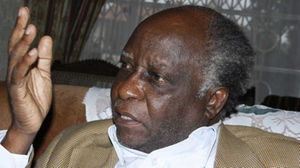
Nick Wambugu, an award-winning filmmaker and a storyteller whose bold vision brings Kenya’s lived realities to screen in ‘The People Shall’.
Photo credit: Pool
On January 27, 2024, hundreds of women and their allies took to the streets of Kenyan cities, calling for an end to femicide, their cries filled with sorrow and defiance. Wearing black, carrying placards with victims’ names, they cried out for justice for the dead and protection for the living in terror.
The film respectfully starts here, filming not only the march but the mood, gentle resistance, solidarity, and seething pain. What starts as a gendered demand for justice quickly entwines with other grievances regarding governance, inequality, and the increasing economic strain on common citizens.
While anger against the Finance Bill 2024 grows, the film follows the transition of how this shared sorrow becomes the fuel for a national awakening.
From June 18, 2024, when the protests broke out, in open rejection of the bill, but this time attracting everyone from all spheres of life. It is during the next few turning-point days, June 20, June 23, and June 25, that the movie chronicles how the voice of the country swelled as one, transforming peaceful protest into a milestone youth-led revolution. It is in this process, from mourning to mobilisation, that The People Shall derives its strong beat.
Visually, the film veers back and forth between the din of the streets and the grim solemnity of one-on-one interviews. The balance is stunning.
Wide shots of the throngs are broken up by gentle close-ups: a protester’s tear-stained cheek, the weariness in a mother's eyes, the clenched jaw of defiance. This contrast is poetic, haunting, and profoundly human.
Here’s how it came to life.
The editor, Mark Maina, who subsequently reduced the raw material to its final form, outlines a neat three-act structure: the social media frenzy, the eruption of street demonstrations, and the emotional climax of June 25, 2024, the day that protestors stormed Parliament. The film never feels formulaic. It flows like memory, fractured but rational, led by the beat of lived experience and not an editorial hand imposed.
Mark carried the intimidating task of crafting hundreds of hours of chaotic footage into something coherent, something that made sense, a compelling narrative. And he did it with care, imagination, and faith. “It's not really cutting out the footage,” he explains. “You need to bring in light moments, thriller moments, sorrow, anger… We avoided that television-narration approach where you're trying to tell people what to feel. We let the interviewees dictate the emotion.
Mark Maina, lead editor and co-filmmaker of ‘The People Shall’, is an award-winning Kenyan filmmaker, director, and video editor.
Photo credit: Pool
There are interviews with key figures like Boniface Mwangi, Vic, Faith, Khalifa, and more that are added layer by layer, like strokes of paint on a mural.
They are raw, sometimes weepy, but never exploitative. Mark explains the editorial challenge, “Sometimes we had to cut off the tape. Let people cry. Let them remember. That's where the truth lives.”
The filmmakers, not necessarily traditional documentarians, liked their creative side. Painters, writers, and digital artistes, it was a revolution of talent. Mark credits the emotional range of the film to that.
While the team had planned to roll out the documentary on June 25, 2025, exactly one year following Parliament Day, they waited, avoiding the noise from then-dominating political theatrics.
The People Shall is more than just a finished film; it's an in-the-making archive. There are plans to cultivate the footage into a more comprehensive documentary series.