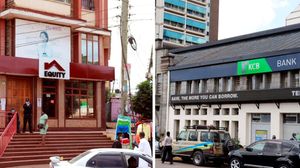
When Christine Oguna left her employer last October she wasn’t sure what her next move should be. “I was not happy with my employer because I felt they were discriminative. I quit with no backup plan,” the 39-year-old, who was heading a department after working in the banking industry for more than 15 years, says.
That was nine months ago. Today, on a quiet and chilly Saturday night we are seated at a corner of her art gallery, named Ardhi Gallery located on Parallel 4 building at the junction of Ole Sangale Road and Mbagathi Way, as Ms Oguna shares how she started the gallery three months ago.
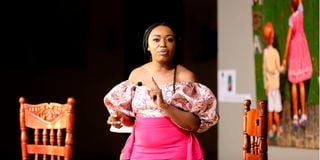
“As I sat at home through those difficult months, I thought about my passions, not money. I have always loved art and visited various art galleries, and uplifting the youth, yet I wondered why I was yet to do anything about my passions,” says Ms Oguna, as various artists who were exhibiting at the gallery private viewing dubbed, 'Safety in my World’, bid her goodnight.
“I decided life is too short to get stuck on something you don’t love,” she says of her idea to start the gallery back in March this year.
“You see I had jumped ship from my great employer to another one because I was offered more money. But after only a few months of working there, I was burnt out. It was a toxic place. Then, it occurred to me that peace of mind and happiness are more important than money. Money is transient. Passion brings fulfilment,” says Ms Oguna.
Still, despite her passion to sell affordable art to Kenyans and her desire to support emerging artists, money was going to play a big role in the success of her gallery.
“I didn’t have enough money, but friends pooled in support either in kind or in hard cash, to make my dream come true.
I combined it with my savings. I also was lucky to get sponsorship from APA Insurance, since it aligned with their CSR goal of supporting the youth.
Can you imagine it took only two sittings and they were convinced? I think people also saw and believed in my passion,” says Ms Oguna, adding that it cost millions, though ‘not more than five’ for the gallery to come to life.
She takes me around the gallery, where various artists have exhibited their art pieces with recycling being a recurrent theme in most.
“While we have a lot of young Kenyan artists we also have a few pieces from renowned ones. The prices also vary,” she tells me as she points to a piece by veteran visual artist, Brush Wanyu, going for Sh890,000 titled ‘Saitoti: Plane Crash’.
While the gallery is yet to break even, Ms Oguna is proud that it’s supporting young visual artists as well as breaking long-held beliefs that Kenyans do not appreciate or invest in art.
“I believe Kenyans also want to own beautiful art. There are people with purchasing power, and I’m changing the narrative that art is elitist and making it affordable,” she says.
One of the ways she is making the art accessible is by cutting the red tape for those who want to be featured on her walls.
Anthony Bulimu is based in South B, Nairobi and loves to play with colour, light and shadows. PHOTO | POOL
“I don’t charge artists for the wall, I make my cut when I sell the art,” shares Ms Oguna who works with art collectives in Kibera and Mukuru slums as well as lone artists.
She also notes that her business model is on the volumes of sales.
“Some of the artists often ask, Why is my art not selling?’ I advise them to lower the prices, and that way they will sell more pieces,” she says.
This strategy has worked as 19-year-old Saviour Juma attests. The Kibera collective artist who makes work from recycled tins, has been consistently selling his art, which he says sustains him.
“I sell 20 paintings per year, with a price range of Sh5000 to Sh100,000 depending on size and quality,” says Mr Juma proudly, as he takes me through his artwork display, as he declares that it signifies, ‘life is a cycle’ and is based on his life experience.
Mr Juma who took to the passion at the age of seven, sees art as having the capability of transforming the youth economically, socially and emotionally.
Savious Juma, 19 with his work which he makes from recycled tins displayed at Ardhi Gallery. The artist is from Kibera Art Collective. PHOTO | POOL
“We started a collective, which helps reform young people who have fallen on hard times. Through art they can escape crime and drug abuse,” he says of their mental health initiative, TAMI.
Twenty-two-year-old Antony Bulimu produces five paintings every two months and with a price tag of between Sh10,000-Sh50,000, he sells at least 20 paintings in a year.
“I dropped out from studying fine arts at Kenyatta University (KU) in 2019 because I wanted something practical. The KU lecturers were too theoretical and cared more about written assignment delivery,” Mr Bulimu, who opted for mentorship from an established artist, Adam Masava, says.
“I have grown very fast as an artist because of this,” he prides, as he introduces his pieces, which portray ‘blessings’ and is inspired by noble scenes in everyday life. “I love colour, light and shadows.”
As the youth embrace art, they are also adopting technology. One such artist is Faith Muthoni Njenga. The 24-year-old is using the emerging art form of non-fungible tokens (NFTs).
An NFT is a digital asset that can come in the form of art, music, in-game items, videos, and more. They are bought and sold online, frequently with cryptocurrency, and they are generally encoded with the same underlying software as many cryptos.
NFTs are gaining notoriety now because they are becoming an increasingly popular way to buy and sell digital artwork.
According to analysts the market for NFTs was worth a staggering $41 billion in 2021 alone, an amount that is approaching the total value of the entire global fine art market.
“I have exhibited at Times Square in New York and my goal is to sell at Sotheby’s (one of the world’s largest brokers of fine and decorative art, jewellery, NFTs and collectables),” Ms Njenga, who is a self-taught artist, says.
Faith Muthoni, 24, with her visual art on strong black women which she also sells as non-fungible tokens (NFTs). PHOTO | POOL
“I hope the NFTs market can get more inclusive of artists of colour,” she muses, pointing to her display of various African women's drawings.
Despite the positives, challenges remain. One, as 24-year-old John Maina points out is in people’s attitudes, especially the elderly, that art is not a worthwhile profession.
“I have uncles who still ask me, “You wake up to draw the whole day? You are an educated man why don’t you get a real job?” Maina, who quit his mechanical engineering career for art, says.
The Thika-based visual artist who uses cardboard boxes for his artworks, says, he is undeterred by the negative remarks, as art is his dream career. “I left employment for art,” he says.
The artist, who works from home, adds that access to the market is a major hindrance.
John Maina, 24, shows his drawings in which he uses cardboard boxes. He is based in Thika. PHOTO | POOL
“I have to come to Nairobi to exhibit because, in Thika, the market is small,” he says, adding that the government can support visual artists by setting up a national gallery.
“Art should be able to pay. You see, for me, when other people are thinking about rearing chicken or running a farm for their retirement, this gallery is my retirement,” Ms Oguna, who projects to sell at least 50 pieces in a good week, says.
She also reveals that she had to go back to work, as she takes care of her ageing parents, and the gallery needs time to turn a profit.
“I sold nine pieces tonight!” she tells me excitedly.