Time flies with great content! Renew in to keep enjoying all our premium content.
Prime
Controversial Kisumu Sikh sculpture restored
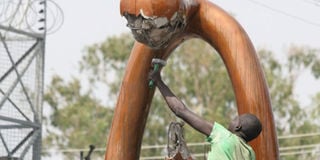
Ondula’s has reconstructed the sculpture at a stone quarry in Kisiani, Kisumu. Photo/FILE
Oshoto Ondula had heard about the so called ‘prophesy’ made about an evil idol coming to Kisumu.
The controversial prophet Dr. David Owuor of the Repentence and Holiness Ministry is said to have ‘prophesied’ that an idol would be brought to the town by so-called ‘devil worshipers’.
Mr Ondula paid no heed to what he heard. The seasoned sculptor put the rumours aside and continued sculpting the peace monument commissioned by Kisumu Sikh community to commemorate the centenary of Siri Guru Singh Sabha Temple.
This was part of celebrating Kenya at 50 and incorporating part of the Sikh story in a town they have been a part of for decades.
“We wanted to play our part in celebrating Kenya at 50,” the chairman of Kisumu’s Siri Guru Singh Sabha, Sardar C. Singh Hayer, said.
“We also wanted the monument to signify the unity of all Kenyans, irrespective of their faith.”
Mr Hayer is the man who commissioned Mr Ondula.
Mr Ondula designed the five meter cement and steel reinforced sculpture in the shape of someone seated with their head bowed in prayer.
“It was meant to be a universal image,” said Ondula.
On February 8th, a hostile mob surrounded the sculpture and brought down. The sculpture was seen to have fulfilled Awuor’s prophecy of a satanic idol.
Local leaders tried to intervene, including former Prime Minister Raila Odinga, but at the end of the day the locals demolished the statue. Mr Ondula was stunned upon hearing that a mob demolished the statue.
The artist believes some members of the mob must have believed the sculpture was made out of bronze due to its golden hue and sandpaper-smoothed shape.
“I think they thought the peace monument was made out of metal which they could then sell as scrap,” he said.
“There was also a rumor that the Sikhs had buried treasure deep inside the monument which gave them added incentive to destroy it,” he added.
For the Kisumu-based sculptor, who created the bronze statue of Tom Mboya which stands erect in Nairobi’s CBD near the National Achives, the mob’s response to his art was a blow.
The late Tom Mboya’s sculpture, which was unveiled in 2011, is popular with fans of Gor Mahia football team who converge at the statue before and after every game, a move that has seen it partially destroyed.
The artist seemed philosophical when we met him during the opening of The Little Art Gallery in Kisumu recently.
“I can understand how people with slight knowledge of contemporary visual art could misunderstand a figure having no eyes, nose or mouth,” Ondula said.
He had made the sculpture in a smooth, modernist semi-abstract style so as to symbolize the universality of devotional prayer. Fortunately, Ondula didn’t have to mourn the demise of the monument for long.
The Sikhs re-commissioned him to reconstruct the peace sculpture and also finish work on two life-sized cement lions that are also part of the installation.
“We hadn’t even completed installing the peace monument when it was vandalised,” said Mr Hayer who is committed to seeing completion of the work.
He is so committed, in fact, that he transported the remains of the sculpture to his company’s stone quarry in Kisiani, outside Kisumu, where Mr Ondula has been working steadily since then.
“The place is like an artist’s sanctuary,” he said, referring to the fact that most of the quarry has been reclaimed after the stone was removed.
Today there are trees all around creating what Onduka calls a ‘heavenly’ ever-green garden. We travelled to Kisiani to see how the artist had reclaimed his artwork.
“It was mainly the head and hands that were damaged,” he said, having restored the statue which he hopes will go back to the roundabout next to the Sikh Temple, in Kisumu City, along with the lions.
“But before I even think of re-installing the peace monument, I want to complete my sculpture of Jaramogi Oginga Odinga,” he said. “My hope is that it will give the people a better grasp of what public art can mean for the community.”
Nonetheless, there are locals who sincerely doubt the Sikhs’ peace monument will ever be accepted by the public in Kisumu.
“The monument will remain a symbol of Asians’ economic dominance in the town, and as such, it may never serve as a symbol of unity as the Sikhs would wish,” said a Kisumu resident. “And if it isn’t destroyed again, it will simply stand as a divisive symbol of inequality between the Asians and African communities.”
Mr Ondula has been sculpting since he was ten years old and in the 1980s former President Moi had commissioned him to create a Carrera marble Eagle for Queen Elizabeth when she visited the country.
He is not as pessimistic as the critics.
“Kisumu is changing rapidly and so are the people,” he said, confident that once they see a monument dedicated to Jaramogi their minds will be opened and accepting of other communities’ desire to beautify their city.
In the meantime, the one redeeming feature of the mob assault on a remarkable work of contemporary Kenyan art is that it’s drawn attention to one of Kenya’s finest sculptors whose first Nairobi exhibition was back in 1979 at African Heritage Pan African Gallery.
Unlock a world of exclusive content today!Unlock a world of exclusive content today!