For years, flower vases were the kind of thing you only saw in glossy magazines or in the living rooms of Kenya’s wealthy elite, placed on marble tables in hallways or on dinner tables.
But of late, vases are almost in all modern homes, and a number of interior décor entrepreneurs are cashing in on the rising demand. Kenyans are buying from vintage vases sold in antique stores, to those made locally or imported and sold online.
Dorothy Owuor, who has found success with soapstone vases, never planned to be in the décor business. Her journey into making soapstone vases began almost by fluke.
“I had just moved to Kisii and went exploring in Tabaka, where soapstone is mined. I had no interest in starting a business then; I was just looking for decor pieces for my home,” she says.
She did not find anything that she liked. “I started wondering whether it would be possible for me to create the kind of pieces I wanted for my home. In the process, I discovered a gap in the local design market for people who, like me, wanted unique pieces, which are as good as the ones on international platforms, but with roots from home as well.”
In 2022, she launched her first vase collection under her Soapstone Interiors business, after months of experimentation.
“We realised that the pieces were being bought not just as flower holders but also as sculptural objects, pieces that could start conversations in homes or offices. So we built a design language around our vases,” she says. “Flower vases now account for around 50 percent of our revenue.”
Though they have been in business for only four years, Ms Owuor believes the demand for vases is on the rise.
“We’ve seen a lot of appreciation and an increase in the desire for authenticity and local craftsmanship,” she says.
Social media has been the game-changer.
“We are majorly on Instagram, and it has helped us reach and showcase our craftsmanship to a very design-savvy audience. We are also able to demonstrate how our pieces are being shipped, styled, and used by both local and international buyers.”
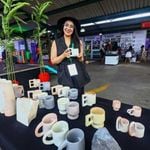
Dorothy Owuor, proprietor of Soapstone Interiors, believes the demand for vases, particularly locally-made ones, is on the rise.
Photo credit: Pool
Over the years, her clients have grown to include homeowners, interior designers sourcing for residential and commercial projects, boutique hotels, and lodges who want to reflect Kenyan culture, and collectors and diaspora buyers who are seeking custom pieces.
But the business has its challenges. Beyond the weather-related hurdles, there are logistical challenges.
“Sometimes it can be difficult to reach high-end buyers without a well-established distribution channel,” she says.
Another flower vase seller is June Njuraita, who owns Wendo Store Kenya in Nairobi.
“For the past five years, there’s been an increase in the number of people wanting to share their lives online, meaning that their homes have to look nice,” she says.
“And when their audiences watch their content, they are influenced into wanting their own spaces to look good as well, leading to people wanting unique vases.”
She established the business in 2023 with only 50 vases made from ceramic, glass, and stone and sourced from India and China. “India is known for having really good rustic pieces,” she says.
Previously seen as an interior décor item for only women, Ms Njuraita says 30 percent of her buyers are men, who also buy a matching vase, a tray, plus artificial flowers.
Where to put it
So, where do you place your vase so that it stands out as a work of art? Daphine Mutheu, who has been doing interior design for 17 years and is the founder of El Interior Designers, says the vase plays different roles in a home.
“If you want a statement piece, then you go for bold colours, unusual shapes, and oversized forms,” she says.
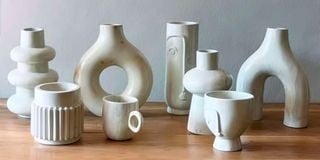
Collection of vases at soapstone Interiors.
Photo credit: Pool
“If you want the vase to play a supportive, accent role, then you go for a more subtle tone or a minimalist design to complement the other decor items. And if you want it to play a functional role in the space, then you pick a vase that can hold your choice of fillers. It all depends on your end game.”
The vases that she has seen trending in the market currently are mostly in line with the popular design themes.
“Most people are going for the contemporary look, so I’m seeing a gravitation toward beautifully-shaped, asymmetrical vases made of ceramic, with glossy finishes and neutral colours, the whites, greens, blacks,” she says.
“But there’s another category that’s going for the boho look, and they look for vases with a more natural finish and ones that are functional so they can put maybe a monstera leaf in it.”
When it comes to styling the vases, Ms Mutheu, who is also an author, says there is a difference when styling an office versus a home.
“For homes pick flower vases that are more playful and flexible, and it gives you more options to work with. You can mix glass, wood, or ceramic pieces, or have different textures, colours, and heights. For offices, however, because it’s a space used by many people and you want the decor to be more accommodating, you’d want to achieve a more formal look. So you’d stick to the neutral colours and shapes and find something simple but that makes a statement as well.”
Lighting is essential when trying to accentuate a flower vase.
“If your vase is the centerpiece, then you definitely need lighting directed toward it so it can stand out. Lighting is also important for vases that have texture, such as stripes or dots, as it brings out that texture and allows people to see and appreciate it.”
The size also matters. The vase would naturally need to be big for a centerpiece, even as an accent piece requires a more toned-down piece of medium to small size.
“If the room is somewhere where people sit and talk, then having a big vase that obstructs conversation is a mistake. You can place it in a corner instead, and let it make its statement over there,” she says.
The other mistake is in buying a beautiful vase meant for the spotlight, and tucking it away in a dark corner where nobody can see it. Similarly, when mixing different vases in a collection, arranging the taller ones in front of their shorter counterparts is another mistake that denies the collection its proper appreciation.
Ms Mutheu advocates for a flexible and fun approach to styling.
“It’s not just the living rooms, vases can be used in dining rooms, bedrooms, entryways, hallways, even in kitchens, and can be layered with other decor items as well. You can layer them with books, candles, sculptures, trays, or beautiful baskets, or even just mix up different textures and materials for visual appeal.”
Another tip the expert shares is having different vases out at different times of the year.
“Vases are not permanent. You don’t have to have the same vases in your house throughout the year. You can switch them up every now and then to give your space a fresh look,” she says.