‘Keep it Kenyan’: Top hotels tweak New Year menus as bookings rise

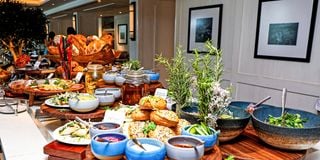
A variety of dishes on display during the official launch of Kwetu Nairobi, Curio Collection by Hilton, on August 30, 2024.

Photo credit: Bonface Bogita | Nation Media Group

High-end hotels in Nairobi saw an overwhelming number of Kenyans visit for Christmas lunch and dinner, forcing them to readjust their menus to cater to diverse customers’ tastes.

By yesterday, some hotels were also almost fully booked for New Year’s Eve fireworks and dinner, which is uncommon compared to previous years.
Hotel officials interviewed by the BDLife said that, much as they were prepared to delight diners’ palates over the festive season, they hardly expected to see overflowing venues. Some had to bar entry of diners at some point.

“This is the first time that we’ve seen that,” said Safari Park Hotel’s assistant sales and marketing manager Samson Mwangangi when he recalled that their restaurant, which accommodates about 400 diners by the swimming pool, was full by Christmas Eve.

They were serving Christmas lunch and dinner at three venues, hosting about 2,000 diners, each paying Sh6,200 per person.

“We had sold it out, so we had to close there,” he said.

At Kwetu Nairobi Curio Collection by Hilton, Mourine Oloo, the director of brand and marketing, said their Upepo and Meko spaces “were fully booked a week before Christmas,” with each diner paying Sh8,500.

“On Christmas Day alone, the hotel served a little over 500 covers, with dining activity flowing organically from lunch into the evening,” said Ms Oloo.

This was replicated at the

Mövenpick Hotel & Residences, where, according to its marketing director Randy Ngala, the Christmas brunch was fully booked before D-day.

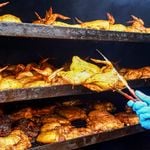
Safari Park Hotel commis chefs Morris Ndigia (left) and Ian Mwangi prepare Christmas brunch on December 25, 2025.

Photo credit: Pool

With more Kenyans opting to stay in the city, and some saving up for the Christmas brunch, family dining has become a key component of festivities, forcing hotels previously used to cater to international palates to readjust their menus to serve locals.

Inclination to stay Kenyan

More local diners means more inclination to stay as “Kenyan” as possible in the food offerings. Various outlets tackled this challenge by swapping international cuisines with better-known dishes.

“Last Christmas, for instance, we tried to introduce the Caribbean cuisine: basically, the Jerk chicken [a spicy, aromatic Jamaican chicken dish marinated with Scotch bonnet peppers, allspice, and thyme, slow-cooked for a smoky, tender finish] and a whole lot of Caribbean dishes. But then again, we felt that diners were a bit pensive when it came to the uptake because it’s an experience that they don’t understand. These are meals that perhaps they’ve only heard of, but they’ve never tried. And you see, with Christmas, it’s a whole family experience. So, you can say some people will be left out because they’re not really, really happy with the dining experience, which is foreign,” he said.

“So, this year, just to play it safe for the whole family range, what we did was that as much as we had to introduce exciting items onto the menu, we also had the kawaida (usual) locally accepted and appreciated Christmas dining menu items,” added Mr Ngala.

“We had the mbuzi choma (roast goat), chicken, but we also introduced something like crocodile meat just to spice things up, because it’s Christmas. With these, someone is sure that if they walk into the hotel, they’ll get whatever they’re used to, and even more, then it becomes easier for the uptake.”

The same approach was taken at Kwetu Nairobi, Curio Collection by Hilton.

“We embraced Kenyan festive traditions wholeheartedly. Nyama choma and locally inspired dishes formed the backbone of the menu. Familiar and nostalgic meals. These were complemented by global dishes but never overshadowed,” said Ms Oloo.

“Nyama choma, prepared at live stations, was a clear favourite, drawing guests back repeatedly. Turkey, done as a festive classic, was equally popular, particularly among family groups,” she added.

It was a busy season for chefs. Most of the high-end restaurants adopted a family-style service approach, with chefs continuously cooking throughout service.

“Dishes were prepared in real time, served in manageable portions, and replenished constantly, keeping meals fresh, hot, and consistent,” she said. Live cooking stations further allowed dishes to be prepared in real time,” Ms Oloo said.

At Safari Park, a whole bull roasting on a spit over fire, a centerpiece of the traditional African barbecue, with meat turning to golden perfection, was introduced at one of the three sites where Christmas dining was held.

“And it got finished,” said Mr Mwangangi. “As the chef was working on the menu, he had to factor [that] in because I know Africans: our [parties] without nyama choma, without barbecue and kachumbari, it’s not a party. So, Africans were really taken care of.”

At Safari Park, their three venues were Café Kigwa (by the pool) with a capacity of up to 400; Theme Park that can hold up to 900 people and nyama choma spaces that takes up to 500 people.

A dish served during Christmas Day brunch at the Kwetu Nairobi, Curio Collection by Hilton.

Photo credit: Pool

Café Kigwa had sold out by December 24. And in the case of Theme Park, no more guests were being allowed in by midday.

“We stopped selling there because it was coming up to capacity due to the walk-ins and people who prefer [coming] last-minute. And when they come in, they have a preference: ‘we want to go to the grounds’ and such. So, at some point, we also stopped selling the grounds. We were left with the third venue: Nyama choma space. This is where we normally have the dancers [the famous Safari Cat dancers], the grill and everything, we directed all the walk-in clients there,” he said, adding that they are anticipating the same successes for New Year dinners.

“For the 31st, we normally do nyama choma only. So, hopefully, the story by tomorrow might also be the same because now [Tuesday] we are at like 75 percent bookings. The last time I checked, we were close to 400 diners who had booked and paid.”

Staycations demand

Staycations remained in high demand, with bookings expected to continue for New Year’s celebrations around the fireworks.

At Kwetu Nairobi, room occupancy “remained strong at 70 percent and above” during the Christmas week, according to Ms Oloo, who added that most people booked between three and seven nights.

“These were largely Kenyan families, including many ‘summer bunnies’ returning home for the holidays,” she said, adding, for New Year’s Eve dinner, by Tuesday, the hotel was “already at 90 percent capacity.”

PAYE Tax Calculator

Note: The results are not exact but very close to the actual.