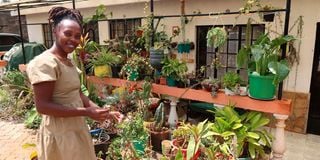
Rhoda Mong’ina’s balcony in Mwimuto, Kiambu County, is a flourishing symbol of her recovery from postpartum depression.
Succulents trail from pots, alocasias stretch their bold leaves upwards, cacti stand tall and spikey, and geraniums burst into colourful blooms.
In the midst of it all, Rhoda smiles softly as she scans the plants, silently admiring the work of her hands, an art that initially never crossed her mind.
“At no point in my life did I ever think of having plants, let alone caring for them. But now, this balcony is my soul garden,” she says. “It is the place I come to breathe, think and reflect on my journey. Every plant here holds a memory and a lesson.”
Her gardening journey started seven years ago, during one of the most challenging periods of her life.
After 22 hours of labour that ended in an emergency caesarean section, she found herself in pain, exhausted and alone. Back home, after she was discharged, the overwhelming silence of her house felt unbearable. She was all alone.
"My body ached, my mind felt heavy, and in my arms was this tiny baby who depended on me for everything," she recalls. “I felt like I was drowning in my own home.”
Confused, exhausted, and on the brink of despair, the 26-year-old first-time mother stumbled upon an unlikely lifeline: "One afternoon, about a month after giving birth, I was out for a walk when I noticed a pile of abandoned succulents by the roadside. There were nearly 50 bulbs left unattended.”
“Most people would have walked past them, but to me, they looked like little companions,” she says. “I picked two—a jelly bean and a tiger’s tooth aloe—and carried them home with trembling hope.”
Rhoda Mong'ina's tending to her plants at her Mwimuto home in Kiambu County on September 11, 2025.
Photo credit: Evans Habil | Nation Media Group
Sadly, those plants did not survive, but even during their short time there, she felt a bit better: "Watering them gave me a reason to get up every morning. That’s how my healing began.”
And so, she went back for more.
First came the snake plant, with its tall, upright, sword-like leaves—a living reminder that she, too, could stand tall again after being broken.
“That plant taught me that I could also rise again, no matter how broken I felt.”
Then came the spider plants, with their arching stems and tiny offshoots that dangle like stars. "They reminded me of myself as a new mother—nurturing, multiplying and giving life to something new."
Next came the bold and radiant anthuriums with their waxy red spathes. “Every time I looked at them, I saw beauty and strength coexisting. They showed me that I could be both soft and strong.”
The sedum had its own story: it was first given to her sister and later returned to her by a friend.
"It started so small, almost hopeless, but it grew. That plant taught me that nothing is ever too small to start again.”
Her ruby peperomia began life as a single leaf. "Watching it grow was like watching myself. From something tiny, fragile, and almost invisible came strength and beauty."
The wax ivy, which has survived house moves and the passing of years, has become a symbol of endurance for her. "Every time I see its variegated leaves, I am reminded that beauty can endure if you continue to nurture it."
One of her favourites is the string of hearts, which was the most expensive plant she has ever bought at Sh1,000.
“I had never seen it anywhere else. It gives me butterflies every time I look at it,” she laughs.
Then there is the Christmas cactus, which she is still waiting to see bloom. Ferns spill over her balcony in feathery waves, geraniums celebrate her victories in shades of pink and red, aloe vera grows plump with healing gel, and peace lilies stand tall bearing serene white blooms.
“Peace lilies don’t just clean the air. They calm my mind, too. They make me feel like I’m breathing in peace.”
Every plant has a message for her. "The cactus, with its spines, reminds me that even in the face of adversity, life can still flourish.
Succulents teach me to conserve my energy. Every new sprout reminds me that growth takes time, but it will always happen.”
A garden with a variety of potted plants at Rhoda Mong'ina's Mwimuto home in Kiambu county on September 11, 2025.
Photo credit: Evans Habil | Nation Media Group
Though small and rented, her balcony has transformed into a vibrant outdoor space. Old buckets have been repurposed as planters, test tubes hold plant cuttings, and D-I-Y stands display her collection.
“Even in small spaces, you can create a forest,” she says proudly. She waters her plants once a week in cooler weather and twice a week in hotter conditions. However, pests have tested her patience.
“The woolly bug wiped out a plant overnight once. It was painful to watch, but I learned to fight back,” she says.
Because of her children, she avoids using harsh chemicals. “I make garlic spray instead. It works and keeps my family safe.” Still, some plants resist her efforts.
"The variegated syngonium has died on me more than once. I’ve tried everything, but I won’t give up.”
The key to successful balcony gardening, she explains, is understanding the characteristics of your plants.
“Every plant has its own personality,” she says. “Some love to bask in the sun all day, while others can get burnt if exposed to too much light.”
By observing how each plant responds, Rhoda has learnt to position them where they feel most at home.
“Once you understand what your plants like, they reward you with fresh leaves, vibrant blooms.”
Starting from knowing nothing about plants, the 33-year-old has built a brand around her passion. She now sells plants and accessories, offers consultations and has designed six gardens for clients.
For those seeking healing through plants, Rhoda advises: "Start small. Even a single pot on a windowsill can transform your mood. Touch the soil, water the roots and observe how life responds. Plants don’t rush you; they grow slowly and patiently. In their rhythm, you’ll find your own...they’ll simply demonstrate that growth is possible, no matter how broken you may feel.
What began as a way to cope with postpartum challenges has blossomed into a flourishing sanctuary. “In caring for my plants, I’ve cared for myself,” she says. “And in their growth, I’ve found my own.”
“Every garden I design is like planting a piece of myself. I want people to know that plants are not just decorations; they are teachers.” Her dreams extend beyond the balcony. “One day, I want to have banana plants and palms here. I want my own little forest,” she says, her eyes shining at the thought.