Time flies with great content! Renew in to keep enjoying all our premium content.
Prime
Growing well-mannered climber, clipper flowers
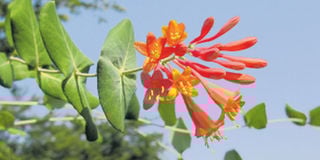
Orange Trumpet Creeper. PHOTO | WIKISPECIES
There is no structure that creeper and climbing flowers can’t alter; from a boring fence to an aging wall.
Creepers and climbers rely on objects and other plants to reach the sunlight. Creepers spread horizontally while the climbers take support of nearby objects or plants.
The beauty with these plants is that they can provide the garden with the burst of colour year-round and with their mass of foliage, cover the walls, trees or fence.
However, without training they can grow and engulf your entire garden and maybe your lawn and walls.
Brenda Kamande, a landscape architect says before growing a creeper or climber, always consider the end result.
“This is the secret to avoiding disappointments in your garden. Always start with the end in mind which basically means that you are clear what you want to achieve,” she says.
While there are many varieties of climbers and creepers that can grow well on Kenyan soil, the petrea, wedelia and golden shower are popular among gardeners.
Clematis, climbing hydrangea, moonflowers, morning glories, bougainvillea and wisteria are also lovely commoners, and come in a big range of colours.
Petrea
This deciduous shrub grows up to four metres tall. It features dropping flower clusters reminiscent of wisteria. Its stems which can grow up to 12 meters have the characteristic habit of twining around other plants for support. Aside from its ornamental blue petals, the petrea is loved for its rough texture leaves, giving it the name sandpaper vine.
“The texture of the leaves is distinguishably rough like sandpaper and its five-loped cup-shaped petals are lavender blue,” says Florence Kiage, a florist at Plants Galore Kenya.
Originally from Mexico, the plant can grow and bloom in areas that are quite shady, but for best results, plant the petrea in full sun. Its flowers which can be light blue, lavender or blue-violet have no fragrance and attract butterflies, adding to the beauty in your home.
Patreas cost averagely Sh800 a piece but the price can go up if the plant is purchased in a flower pot.
Wedelia
If your intention is to have a yard that is green, lush and inviting, then this flowering plant of the sunflower family is the perfect choice.
The wedelia is referred to as the rabbit’s paws, the trailing daisy or the yellow dots. Yet in other quarters it is known as the creeping ox-eye.
Its dense ground-hugging foliage at times chokes out weeds as its yellow daisies, which it bears all year round, remain a sight to behold.
You can convert your grass lawn to a wedelia delight within a short time.
“One way is to suffocate the grass on the lawn by covering it with overlapping flattened cardboard, then on top of these, apply six inches of free mulch,” Ms Kamande says.
After a few months, the ground should be ready for planting of young wedelias.
Alternatively, cut deep into the lawn with a shovel and insert the wedelia cuttings into the dug-up holes.
Water them frequently for one month to allow the rooting system to develop then cut the supply to twice a month to allow the wedelia to take over the lawn. While wedelia is a perfect substitute for thirsty lawns, the plant does not produce undergrown stolons and has minimal seed production.
“As such, it is advisable that you confine it to areas such as driveways, sidewalks and edgings,” the landscape architect says.
Orange Trumpet Creeper
This is a fast-growing vine with tubular yellow, red or orange flowers and greatly attracts humming birds.
Another common name used to refer to this plant whose flowers are succeeded by six-inch pods is the trumpet creeper.
It can do well under partial shade or in full sun. However, pick the location it will grow with utmost care as planting the vine too close to your home could see its creeping root damage property. It is very aggressive.
With a little training, this creeper can become a climber and can grow to cover one side of a building.
“Caring for them is easy as you only need to prune away spent flowers to encourage new ones to bloom,” says Ms Kamande.
As creepers, the trumpet creeper is useful in prevention of soil erosion during the rainy season.