Time flies with great content! Renew in to keep enjoying all our premium content.
Prime
How CEOs stay fit, yoga thrice a week and CrossFit at lunchtime
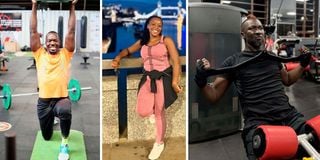
From left: Albert Mandela, Executive Director at Luton Hospital; Phyllis Wakiaga, Senior Adviser (Global Lead) at the Tony Blair Institute for Global Change; and Dr Maxwell Okoth, CEO of RFH Healthcare.
They sit in corner offices behind stretched-out desks with piles of documents and big decisions to make. They are constantly travelling, hauled up in meetings and bearing the burden of leadership.
Many of them, due to tight schedules, do not find time to work out for physical and mental wellness. They are corporate leaders.
BDLife caught up with bosses who have managed to centre their lives around fitness, despite hectic schedules.
At 39, Albert is the executive director and founder of Luton Hospital, a Level 4 private healthcare facility in Nairobi. While his day job involves managing healthcare teams and navigating operational challenges, he credits his consistent fitness routine with sharpening his leadership skills.
“I’m a social scientist by training, not a doctor,” he says. “But staying fit has made me a better entrepreneur, employer, and decision-maker.”
Albert’s journey into fitness began in childhood. After suffering two separate leg fractures by age 13 — one from a gymnastic fall and the other from a road accident —he didn’t walk properly until he was 15. The injuries sidelined him during his school years and sparked a desire to regain control of his body.
He started informal workouts at 20, paused in his mid-20s, then resumed at 29. Now, over a decade later, fitness is a non-negotiable part of his lifestyle. His routine includes yoga three mornings a week, lunchtime gym sessions focusing on powerlifting and CrossFit, weekend tennis matches with his son and regular long-distance running.
Albert Mandela performs a barbell front squat workout at Alpha Fit Gym along Ngong Road, Nairobi on July 4, 2025.
Photo credit: Bonface Bogita | Nation Media Group
“I’ve set a target to run 400km this year with a group of friends,” he says. “We log our progress every weekend.”
Running a hospital doesn’t allow for a fixed schedule, but Albert adapts.
“I train at whatever time my calendar allows, mornings, lunch hour, or evening. I plan for it the same way I do meetings. When I travel, I look for a gym wherever I go. It’s part of my rhythm.”
For Albert, fitness directly enhances his executive function.
“Training helps me clear my mind. When I’m dealing with HR issues, finance, or crisis management, that one hour of movement resets me. I come out sharper, calmer and more focused.”
He believes discipline in fitness pours into professional life.
“The gym teaches consistency. Some days are tough, but you still show up. That mindset translates to how I lead my team or pursue goals.”
His strict diet mirrors his training discipline. He hasn’t had soda in over a decade, avoids sugar, fast food, and practices intermittent fasting.
“Diet plays a central role in fitness. It is counterproductive to train hard, work out for long hours then fail at what you put into your mouth. It also teaches you self-control, which reminds you of something important about leadership and that is, delaying gratification, managing emotions, and making rational decisions under pressure.”
His discipline has spilled over to his household.
“My children don’t even ask for sweets. They’ve never seen me eat any.”
Even with his laser-sharp focus on healthy diet and clean eating, Albert falls into temptations at times. “I’m trying to reduce. Chapati is the one area I need intervention!” If he were to draw parallels, this would be the equivalent of the human side of his leadership. “It reminds me I am human, even when I lead a huge team as I do, I can make mistakes, and I am not immune to failure. But I have to avert a crisis.”
Beyond personal gains, Albert sees his fitness as leadership modelling. “I want my team to see wellness as normal. If leaders prioritise health, employees follow. In other countries, executives have gym memberships and wellness programmes. Why not us?”
Albert Mandela performs an upward-dog exercise during his workout at Alpha Fit Gym on Ngong Road in Nairobi on July 4, 2025.
Photo credit: Bonface Bogita | Nation Media Group
For his peers in the C-suite, he says, “You can’t pour from an empty cup. If your body is failing, your leadership will too. Just start—walk, stretch, jog. It’s not about six packs, it’s about stamina, clarity, and resilience.”
For Phyllis Wakiaga, Senior Adviser (Global Lead) at the Tony Blair Institute for Global Change, former CEO of the Kenya Association of Manufacturers (KAM) and a renowned leader in policy and governance, fitness is not just about movement — it is about grounding, clarity, and discipline.
The 43-year-old’s journey into fitness began in university, with simple skipping routines and long walks during daily commutes. But it wasn’t until her career took off that she fully grasped the link between physical stamina and sustained performance.
“When I started working, I realised that effective leadership requires both physical and mental strength,” she says. Faced with growing professional and family responsibilities, she knew she couldn’t afford to be physically drained.
Her initial morning and weekend walks with her fitness-enthusiast spouse quickly evolved into a lifestyle anchored in intentional movement — whether at home or while travelling for work.
“Now, with frequent travel, I make it a point to find a gym or take a walk in every city I visit.”
Phyllis Wakiaga on an evening walk in the streets of London in July 2024 (left), and on a routine evening walk in Nairobi in July 2025.
Photo credit: Pool
Beyond physical health, fitness is her mental reset button. When faced with complex decisions or emotionally demanding days, she turns to early morning walks to regain focus.
“Fitness helps me think more strategically,” she says. “It’s not a perfect formula, but it consistently helps me find clarity and make grounded decisions.”
Phyllis sees fitness as a mirror of leadership discipline. “It builds emotional endurance and teaches consistency — which is what leadership demands,” she avers. Whether it's squeezing in a walk after dinner or waking up at 5am to move her body, she treats these routines as high-priority meetings.
During her tenure at KAM, Phyllis didn’t just walk the fitness talk — she brought her team along. She launched the KAM Fitness Club in partnership with a nearby gym.
The results were transformative: “Colleagues were more energised, motivated, and productive,” she recalls. The club spurred a healthy competition, boosted morale and built accountability across departments.
Her fitness time is also a moment of intellectual and spiritual nourishment. While walking, she listens to podcasts and audiobooks — drawing ideas and solutions for real-time challenges.
“It’s amazing how often a walk helps me find a lightbulb moment,” she says. Her creativity, she believes, is deeply tied to these quiet, consistent moments of movement and reflection.
For her, fitness is more than self-care — it is leadership preparation. “When you feel physically well, you lead differently,” she emphasises.
And to women juggling full schedules and families, she offers this advice: “Fitness is not optional. Start small — even a 15-minute walk counts as progress.”
Phyllis’ world constantly demands more. Even then, she is ever so present and committed to remind herself that showing up fully, clearly and consistently begins with showing up for your own well-being first and leadership’s biggest task is showing up.
Maxwell Okoth
Dr Maxwell Okoth’s leads a highly industrious life. The 39-year-old is a trained medical doctor, a serial entrepreneur and the founder and CEO of RFH Healthcare.
His fitness journey only started a year and a half ago, even though his well-chiselled body could falsely point you to believing he packs in years of heavy lifting in the gym. “If it’s by my looks, then I should thank God—it’s mostly genetic,” he says with a laugh.
For most of his adult life, he leaned on natural activity, like walking, rather than structured workouts.
Dr Maxwell Okoth works out at Millenium Gym in Runda, Nairobi.
Photo credit: Pool
But in 2023, the demands of entrepreneurship began to weigh heavily on him. “Running a business is an extreme sport,” he says. “It’s high-stress, chaotic and draining. I needed a healthier way to release that pressure.”
Enter fitness—not as a vanity project but as a survival tool.
Dr Okoth began waking up at 5 am to train with a private coach. His push to pursue fitness came from his wife. “I was tossing and turning every night. My wife, who’s big on working out, encouraged me to try it,” he recalls. “Soon, I was sleeping better, thinking more clearly, and feeling stronger.”
Today, fitness is his anchor. “When I don’t work out, I feel off. It’s become part of who I am.” He compares early-morning workouts to lighting a fire under his day: “By 6 am, I’ve already achieved something. I’m energised and ready for the madness that comes with running hospitals.”
Beyond the physical benefits, he’s drawn parallels between working out and entrepreneurship. “Those first few weeks are painful,” he admits. “You want to quit. But if you stick with it, the discipline pays off. Just like in business—you start small, build consistently, and push through discomfort.”
Tracking progress has also been key. “My trainer records my weight, BMI, and progress monthly. Without that, you’re just spinning wheels. I once gained weight while working out because I wasn’t watching my eating habits.”
For Dr Okoth, data and dashboards apply not just in fitness, but in business, relationships, and personal development. “You have to keep records to know where you stand, what you have conquered and what stands ahead of you. Unless you know where you are, you will not know where you are going and how to get there in the first place.
Dr Maxwell Okoth works out at Millenium Gym in Runda, Nairobi.
Photo credit: Pool
Though fitness is currently a personal journey, Dr Okoth is keen on expanding it into his organisational culture.
“We’re already big on mental health, but we’re planning to add a fitness component—maybe even a staff gym. When the team is healthy, everything else thrives.”
His parting advice to fellow leaders, especially those in high-pressure roles? “Find something that diverts your energy positively. It could be fitness, golf, or something else—but you need an outlet. Without it, we burn out or fall into destructive habits.”