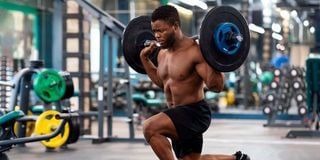
The joints involved in doing a squat are the ankle, knee, hip and the spine. Interestingly a squat is one of the first things we learn to do before learning to stand and walk as babies. So, what changes as we grow up?
Our bodies undergo a series of growth spurts and with that comes different strength and flexibility. This is all dependent on the environment activities and one's genetic make-up as well. So, as time goes by, our bodies go through different levels of flexibility and strength.
Keeping all these in mind, why do we sometimes have difficulty squatting or maintaining it? Well, it’s simply because of stiffness in the joints (ankle and hip) and muscles involved.
If you find that you are unable to go past parallel with the squat or you have to lift your heel to go on your toes.
It could be due to poor mobility at the ankle. If your ankles are restricted, poor mobility could come from joint stiffness mainly of the muscles at the back of your leg (calf muscles).
Arch problems are another cause. An arch that’s too high or too low (flat feet) places more stress on the ankle joint and can cause degenerative changes that cause ankle stiffness.
Another cause is a history of ankle sprains. This makes for either a stiff joint or an unstable joint.
To improve your ankles mobility two exercises are recommended. The first, heel lifts where you rise onto the balls of your feet and slowly return to the starting position in a controlled manner. The second is toe and heel walks. To do this straightforward exercise, walk across the floor on the balls of your feet. Then walk back on your heels. Keep alternating.
Poor hip mobility
Sitting in one place for too long causes the hip flexor muscles to shorten and tighten. Be sure to stretch the hips more often and to restore mobility in the hip. The flexor lunge is a good way to stretch the hip. Strengthening your hamstrings and glutes with exercises will also help to balance the muscles at the hip.
You’re anatomically not suited to squat low
Mobility is one issue, but some people have an easier or harder time squatting deep because of their anatomy. For example, you’ll have an easier time doing a deep squat if you have a longer torso length relative to the length of your femurs, the big bones that make up your thighs.
Height makes a difference too. If you’re tall, you have more distance to travel to get into a deep squat. Shorter people have an advantage here! Also, if you have long femurs and a short torso, you’ll lean your torso forward when you squat rather than standing upright.
You can’t control your anatomy, but there are some adjustments you can make that will make it easier to squat deeper. If you have long thigh bones (femurs), widen your feet more and turn your toes out a bit. Doing this makes it easier to squat lower. If you’re using a barbell, place it higher on your back.
In summary, the hip and ankle stiffness are a major stumbling block for many people in their squats. Work on flexibility and strength at these joints and the form and ease will improve progressively.
Ms Waihenya is a physical therapist at Chiropractic & Physiotherapy Health Centre
Unlock a world of exclusive content today!Unlock a world of exclusive content today!