Time flies with great content! Renew in to keep enjoying all our premium content.
Prime
Mobile X-ray machine promises bed-ridden patients easy access
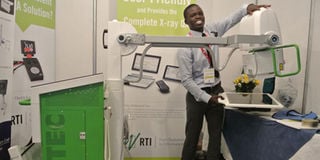
Stephen Sakania, Biomedical Engineer at Retina Medical Supplies demonstrates how the mobile Protec x-ray machine works. PHOTO | SARAH OOKO
Jeremy Nandwa is a cheerful teenager. His friends in Nairobi’s Milimani Estate are accustomed to his loud laughter and whistling tunes, especially during weekends when he cycles away in the neighbourhood.
It was during one of these cycling sprees that Nandwa suffered a gruesome accident five years ago and ended up breaking his leg and arm. Though he is well now, the Form Four student still remembers the excruciating pain he endured every time he was ferried from his third floor hospital ward to the ground floor for X-ray imaging.
“This was the worst part of my hospital stay and just thinking about it gives me the chills up to now,” he tells the Business Daily in an interview.
However, a mobile X-ray technology dubbed Protec Proslide 32-DR Touch that is now available in Kenya may change the state of affairs.
The first of its kind in Kenya, the machine is expected to revolutionise medical imaging in a sector that has predominantly relied on fixed units, inconveniencing patients.
“Since we shipped it here two months ago, we’ve trained hospitals on its operations. And many have now placed orders,” says Mr Stephen Sakania, a biomedical engineer with Retina Medical Suppliers Limited, the Protec company’s agent in East Africa.
With the new machine, Kenyans will have access to a technology that has so far been the preserve of the wealthy nations in Europe or North America.
Unlike the heavy and immobile machines, the new one is smaller and lighter, making it suitable for the critically sick whose health may be compromised by frequent movements.
“These patients now don’t have to go to the machine; it will come to them wherever they are,” Mr Sakania explains.
Most advanced X-ray units in the market use cassette-based Computed Radiography technology to record images. Studies have shown that during processing, images recorded in cassettes may degrade by about 15 per cent or even more in case of delays.
The mobile Protec X-ray machine use Digital Radiography (DR) technology, one of the latest. It uses digital sensors that produce images as soon as they are taken.
“You take the image and the doctors can view it from the machine’s inbuilt computer immediately,” Sakania explains.
This, therefore, enables hospitals to cut on processing costs and spare patients treatment delays. The DR technology also uses minimal radiation.
The digital medical images taken by this mobile machine are manipulable to increase magnification or colour intensity, thus enabling doctors to interpret the images. Protec boasts a touch screen interface that allows users to slide through commands.
The mobile machine requires about 230 volts of power compared to the 415 volts for the immovable technology. In case of a power blackout, the computer has a back up battery that ensures x-ray images are not lost or destroyed.
No guesswork
Upon creating profiles of patients, the new technology allows radiologists to take images of various body parts. “There’s no room for guesswork or mistakes,” Sakania says.
Technicians with minimal training can learn on the job, relying on the directions provided. The Protec mobile x-ray unit retails at Sh6.5 million.