Venture capitalists are scrambling to invest in Kenya’s electric mobility businesses, committing multi-billion shilling investment rounds as the country emerges as one of Africa’s fastest-growing markets for electric vehicles.
In the last 15 months, investors ranging from development finance institutions to specialist climate-tech funds have poured money into Kenya-based electric-vehicle assemblers and mobility-focused venture firms.
Motorbikes and three-wheeled tuk-tuks, are the centrepiece of a move to make transport green and reduce air pollution.
The government hopes the prospect of cheaper running costs will create a gearshift in the minds of other drivers of boda-bodas, most of whom still use petrol or diesel.
Transport accounts for about 40 percent of Nairobi's air pollution, and globally for about 20 percent of greenhouse gas emissions, according to the Clean Air Fund.
But the appetite for EV products has triggered a flow of venture capital.
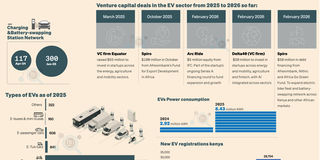
In February, electric motorbike maker Spiro secured $50 million (Sh6.4 billion) in debt financing from Afreximbank, Nithio and the Africa Go Green Fund to expand its fleet and battery-swapping network across Kenya and other African markets.
The funding came just months after the Nairobi-based firm, which also operates in Uganda and Rwanda, secured $100 million (Sh12.9 billion) in October from Afreximbank’s Fund for Export Development in Africa.
Venture firms
Its rival, Arc Ride, this month closed a $5 million (Sh644.8 million) Series A equity round from the International Finance Corporation to scale its operations.
Upstream, venture firms are raising dedicated pools of capital to capture the sector’s momentum.
Delta40 raised $20 million to invest in startups across energy and mobility, agriculture and fintech, while Equator closed a $55 million fund in March 2025 targeting energy, agriculture and mobility ventures. The funding wave coincides with sharp growth in local EV infrastructure and demand.
According to the Electric Mobility Alliance of Kenya, charging and battery-swapping stations have increased from 117 in April 2024 to 300 by June 2025, though 90 percent remain concentrated in Nairobi.
Power consumption data also illustrates the acceleration. Kenya Power reports that EV charging consumed 8.43 million kilowatt-hours in 2025, up from 2.92 million kWh in 2024 — a 188 percent increase.
Revenue from e-mobility customers rose to Sh190.8 million from Sh64.8 million during this time.
Similarly, EV registrations have jumped from 1,378 in 2022 to 28,754 in 2025, according to the Africa E-Mobility Alliance. Two- and three-wheelers dominate registrations, reflecting the economic logic of electrifying the boda boda sector, where high daily mileage makes fuel savings immediately tangible.
Investors are drawn by Kenya’s high motorcycle density, a power grid largely supplied by renewables and a policy environment that has signalled support for electric mobility.
Experts say the next growth phase depends on expanding charging networks beyond Nairobi and providing policy support to incentivise passenger car uptake.