Time flies with great content! Renew in to keep enjoying all our premium content.
Prime
Ultrasound machine takes screening past black-and-white foetus images
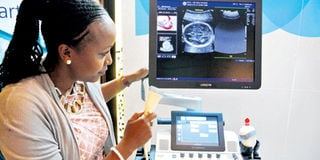
Ms Susan Wanjau, the GE Africa advanced applications specialist, explains how the Logiq F8 ultrasound works. PHOTO | SARAH OOKO
Mercy Mueni lost her first born child in 2010 out of what she says were breathing complications at a rural hospital in Kitui County. She later learnt that the problem was as a result of her umbilical cord twisting around the baby’s neck.
This pregnancy anomaly would have been detected early enough by an ultrasound machine, but the hospital lacked the technology. Ms Mueni represents the more than 6,000 women that die annually from preventable maternal complications, mainly due to lack of, or insufficient medical diagnosis equipment to monitor their pregnancy.
However, recent developments offer hope that such problems may soon reduce or be eliminated altogether.
General Electric (GE) plans to roll out one of its latest ultrasound technologies — dubbed Logiq F8 — across Kenya by September.
Conventional machines
This technology forms part of the Sh21 billion radiology equipment that the company has been contracted by the Ministry of Health (MOH) to deliver to all counties while managing them for a period of seven years.
Some conventional ultrasound machines deal only with maternal conditions such as checking the unborn baby’s size, position, heart rate, physical development and due date.
But apart from pregnancy-related complications, this new GE digital ultrasound is also ideal for diagnosing cancers, heart problems and abdominal problems (like appendicitis, endometriosis, fibroids, kidney stones and ovarian cysts).
Susan Wanjau, the GE advanced applications specialist for Africa, notes that the Logiq F8 machine’s selling point is its shared user capability.
“People like it because it can perform various functions. So they don’t need to keep buying different machines.”
Umbilical cord
The ultrasound machine comes with four different types of probes —three dimensional (3D), endovaginal, linear and convex — performing various roles. The three dimensional (3D) probe enables doctors to scan features of unborn babies.
For instance, it allows clinicians to see how the umbilical cord coils around a baby so as to ensure that its blood flow and breathing are optimal.
Aside from the static 3D images, mothers also see the baby in motion and colour. They can see the foetus smile, yawn or suck on their fingers just as they would a new born baby. This is unlike the conventional two dimensional (2D) type that yields only static superficial pictures — in black and white — thus offering an incomplete image.
Through the endovaginal probe of the GE Logiq F8 ultrasound, doctors are able to delve deep into a woman’s body to monitor early pregnancies when the foetus is still tiny.
“They can check to see if the amount of amniotic fluid in the uterus is sufficient and if the baby’s heart rate is normal,” says Ms Wanjau.
The linear probe scans blood vessels in the body — (be it veins or arteries) to determine whether obstructions such as clots exist. It can also identify blocked arteries causing decreased blood supply to the brain.
This type of scan can enable doctors to catch cancers such as thyroid, breast and prostate early, thus improving treatment outcomes.
Telemedicine feature
The convex probe is ideal for detecting anomalies in body tissues such as liver cirrhosis and ovarian cancer.
During scan, the Logiq F8 ultrasound makes it possible for sonographers to save videos of processes best illustrated in motion such as heartbeats of babies in the womb. The images may be sent by Internet directly from the machine.
This telemedicine feature of the machine is especially key to Kenya as there are only few doctors dealing with specialised conditions such as gynaecologists, cardiologists, and oncologists.
“These doctors won’t need to be physically present at all county hospitals. They will just receive the images at a central place, look at them and respond via a computer, mobile phone or iPad.”
The images taken by the GE ultrasound use raw data technology, providing real time medical images taken from various patients that doctors can manipulate to diagnose.
“It’s like they have the patient right there with them all the time,” explains Ms Wanjau.
Digital tutor
The machine is also user-friendly. Once radiographers choose a particular probe to use, it automatically informs them of its functions and offers pre-set parameters for performing the scan.
For skills advancement, the ultrasound technology comes with a digital tutor known as the ‘scan coach’ to guide technicians.
Its adjustable monitor allows viewing of images from various angles and even move them closer to mothers who would also like to monitor their babies’ development. The Logiq F8 ultrasound costs Sh5 million.