Time flies with great content! Renew in to keep enjoying all our premium content.
Prime
Hotel that offers a walk through Swahili history
Photo/Courtesy/Swahili Beach Resort
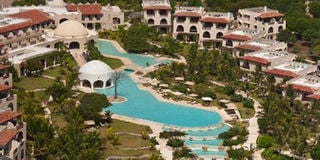
The hotel, which sits on 20 hectares, opened its doors in December last year.
As you are about to land at Diani Airstrip, as the pilot’s stuffy voice comes on to inform you that you will be landing soon, take a moment to look down at Ukunda town.
From the air, Ukunda looks like a small town that has been abandoned. A small coastal settlement that a “bad wind” swept through and almost wiped everything out.
Like one of those epidemics in earlier times for instance, some strange disease that made old men cough incessantly on their verandahs and dogs sneeze under coconuts trees.
This might sound a tad dramatic and ominous, but that doesn’t mean Ukunda is not idyllic.
Actually it is quite a fetching town from the air; the worn and aged iron-sheet roofs and the white buildings that the salty air has turned into an off-white colour.
And at the edge of these historic-looking “ruins” at the edge of the mangroves, a long sparkling white patch of sand trot alongside the town like a silver lining. It is beautiful yes, but still it manages to break your heart a little. Ukunda looks unhappy from the air.
And when you think about it, the reason this town looks desolate from the air is because it looks artily enigmatic, untouched.
While Mombasa looks abused and violated from the air – a town that is crying out for overtime – Ukunda looks like it doesn’t care whether you come or not, it looks aloof, and that lays the magic of Diani.
It incites your curiosity. Ukunda is a like a woman who is interested but makes a big production of looking disinterested.
Fifty years ago, Diani was a small fishing settlement. In fact, there were only about 1,000 beds in the whole of coast region.
The hotels in Mombasa mostly catered for the businessmen, but there was not much along the beaches, north or south. Tourism, the animal, was just stirring from its birth-bed.
Beach Hotels
North coast was first to develop beach hotels in the late 30s – 40s. Whitesands Hotel, sprung up, then Nyali also followed suit. Diani remained dormant.
In the 1970s tourists started flocking to Kenya because Kenya, in the region, was one of the countries untouched by war or strife.
Hotels mushroomed along the five-mile coast road. The airstrip that you land on in Diani was built, literally by hand and after its opening, was blessed by the late President Mzee Jomo Kenyatta. Jadini came up, then Tradewinds and then TwoFishes.
Over time, Diani has developed into the cosmopolitan resort it is now. Diani has come of age.
The architecture in Diani, as is common with other Kenyan coastal towns that sit on the 500kms stretch from Lamu archipelago at the north to the Tanzanian border to the south, is remarkable.
It’s soaring with makuti thatched roofs, clean white sand and lagoons protected by an offshore reef.
Then there are the marine parks, a concept that was born in the 70s to protect areas where guests would see marine life on the south coast.
Kisiti Marine Park and Mpunguti Marine National Reserve was gazette as nature reserves.
Both are within 3-8m off the shoreline and extend to about 6km north of Tanzanian border. It was the first marine park to be gazetted in Kenya. But the fishermen protested to the government because it meant blocking access to their livelihood.
A compromise was made and the area of the park was reduced to 11sq km and 18sq km for marine reserves managed by Kenya Wildlife Service.
Only officially licensed fishermen from the locality are allowed to fish in the area using traditional methods.
The latest entrant to the resorts in Diani is Swahili Beach Hotel, which opened in December last year. The resort, which sits on 20 hectares, is an architectural genius that borrows heavily from the old Swahili culture.
You will get a sense of Lamu in it, a sense of Zanzibar and quite often the old sultan lifestyle will also come through. The interior décor was done with the objective of resurrecting that old Swahili culture.
The ceilings are high, allowing the breeze to swirl through thus helping cooling the temperatures. Furniture is all made locally by - Ramboo Ltd – also affiliated with the hotel.
The landscaping, done by Bruce Hopkins, gives the place a paradise like feel. And indeed the word “paradise” isn’t a hyperbole in this case.
You will also find it stupefying that they have some eight swimming pools, all fed with 3 million litres of water every day.
Some four bars and a couple of restaurants more and you a unique resort that is free to toot its own horn.
Swahili Beach Hotel is such a fresh and brilliant concept that when small pockets of unsatisfactory service came up while I stayed there recently, I was quick to choke it down to teething problems, besides they are only four months old.
With swanky resorts like Swahili Beach, Diani is fast building its portfolio as the playground for the rich.
Unlock a world of exclusive content today!Unlock a world of exclusive content today!