Time flies with great content! Renew in to keep enjoying all our premium content.
Prime
Maestro of Cuban jazz, Bebo Valdes, dies in Sweden
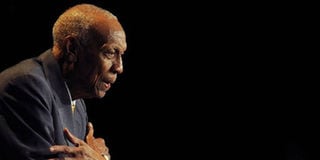
Cuban musician Bebo Valdes during the celebration of his 90th birthday in Madrid. AFP
The death of Cuban pianist, arranger, composer and bandleader Bebo Valdés two weeks ago, offers music lovers a chance to reflect the contribution of the island to the evolution of popular jazz music. Valdes, one of the leading lights of the Golden age of Cuban music in the 1940s and 1950s, died in Sweden at the age of 94 from pneumonia, he also had Alzheimers.
Latin rhythms have been present in jazz since its beginnings in New Orleans. From Nat King Cole to Frank Sinatra, Dizzy Ellington to Ella Fitzgerald, the best of American jazz musicians have gained vigour and inspiration from Latin rhythms.
Valdes was among a generation of Cuban musicians, like Armando Romeu, Frank Emilio, Peruchin and Cachao who were influenced by North American jazz and created a parallel movement of Latin jazz. He was at the forefront of a movement that created a vibrant, melodic style of Cuban music, which still remains popular more than 50 years later.
The 6 foot 4 musical giant, who was nicknamed El Caballón or, The Big Horse, was born Dionisio Ramon Emilio Valdes Amaro, on October 9,1918 in Quivicán, south of Havana. As a teen he enrolled at the Conservatorio Municipal in Havana to study classical music and thereafter spent four years as a pianist and arranger for the Cuban radio station Mil Diez.
Valdes worked with American stars including Woody Herman and Nat King Cole while playing at the Tropicana Club, Cuba’s most glamorous nightclub from 1948 to 1957. He gave Spanish lessons to Cole and arranged the music for the legendary singer’s “Cole Español,” album, recorded in Havana in 1958.
In 1952, he was part of the first descarga (jam session) recording made in Cuba with American producer Norman Granz, founder of the Verve record label. He also introduced the bata, a two-headed drum used in Afro-Cuban religious ceremonies, into popular music creating the batanga, a fast and intricate dance style.
The maestro founded his own orchestra, Sabor de Cuba (Taste of Cuba) in 1959, with his teenager son Chucho, often appearing as a pianist. Chucho has gained his own respect as an ambassador for Cuban music worldwide.
Tropicana closed down during Fidel Castro’s revolution, in 1959. A disconsolate Valdés left Cuba moving first to Mexico and then to Spain where he found work as a pianist and an arranger for television and recording studios.
While on tour in Sweden, in 1963, he meet his future wife Rose Marie Pehrson. Stockholm was to be his home for the next three decades where he played piano in the city’s lounges. Valdes never returned to Cuba. It was saxophonist Paquito D’Rivera who persuaded him out of retirement to record an album, titled “Bebo Rides Again”, in 1994.
A decade later, he recorded “Lagrimas Negras” (Black tears) with Spanish flamenco singer Diego El Cigala, the album was an acclaimed international hit.
He featured in some Spanish films and documentaries. “I don’t think I have known anyone straighter and nobler,” writes Trueba in one of the film’s notes about Valdes. “He doesn’t have to demonstrate anything. Music flows from him in a natural way. If anyone wants to know what ‘swing’ means then all they have to do is listen to Bebo.”
Last year, the animated film “Chico and Rita,” inspired by the story of Valdes’s life in Cuba. It was nominated for an Academy Award for best animated feature.
Despite his ill health, he composed and recorded music for the film Bebo Valdes maestro won three Grammy Awards. His death closes the chapter on one of the most influential figures of Cuban jazz who remained a torchbearer for the island’s music even as he spent most of his life in exile.
Unlock a world of exclusive content today!Unlock a world of exclusive content today!