Across the whole history of the motor car, what low-cost mass-production models have best represented the values of go-anywhere, do-anything, and always-get-you-home reliability and/or fixability? Oscar
There are lots of models that have many of those qualities, but very few that have them all. “Low-cost” will mean quite small and basic.
“Go-anywhere” demands good ground clearance, large wheels, adequate suspension travel, effective traction and low gearing.
“Do-anything” would include flexible seating and/or luggage space.
“Reliability and fixability” needs quality and simplicity of design, materials and construction.
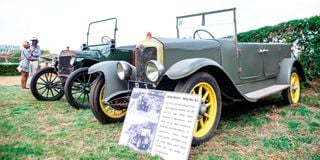
The first car to get nearest to that combination was arguably the Model T Ford. It never set a “quality” benchmark (Rolls Royce was already doing that peerlessly, and in the little car class the Austin (designed by one of the all-time great engineers, who also designed the machines that manufactured the parts) was far better engineered and built than the Ford, which for good reason was nicknamed “Tin Lizzy”.
But by prioritising low price the Model T revolutionised affordability by pioneering mass production, it was certainly small and basic, but had light weight, big wheels, good ground clearance, and its skeleton allowed the body to be adapted to all manner of configurations…or could be removed altogether.
Its crude engineering did not make it reliable, but simplicity made it eminently fixable (and gave its owners lots of diy practice). By sales volumes, it conquered the world, outstripping any other make or model for at least a decade. It captured 50 percent (!) of the Kenya market, working as everything from a town taxi to a farm tractor.
Next to hit the market bullseye in those respects was perhaps the VW Beetle, designed on the same principles but built to a whole new level of engineering.
Its target was not a secret (The German word “Volkswagen” literally means “the people’s car”); but it was based on the KDF Wagen (the German acronym for Hitler’s “Strength Through Joy” slogan – Kraft durch Freude) designed by Ferdinand Porsche (yes, that one).
By both deliberate design and a twist of fate, the Beetle emerged as a military vehicle in World War II (there was even an amphibious version…with 4WD) and production was financed by a military budget.
It was extremely robust, dependable, air-cooled, coped well in rough terrain and had enough leg and head room for burly occupants in battle gear…but rather limited luggage space.
In that era it was almost uniquely aerodynamic, and the tortoise-shell shape also made it extremely strong. In this and several other respects it was more likely than any modern car to survive being shot or blasted by an explosion.
After the war it was resurrected under initial British (Martial Law) management and became a global best-seller for decades; and production went on for more than half a century…ultimately in Brazil.
Several other makes and models have achieved iconic status as beloved little workhorses over the years – the Willys Jeep from the US, the Trabant in East Germany, the Soviet UAV, the Fiat Cinquecento from Italy, The Renault 4L “Roho” from France, and even the British Mini) all ticked many of the boxes. But the one I would pick out as a special pioneer of the genre, and which ticked all the boxes in the late 1950s and early 60s, was the Citroen 2CV – in particular, its “Sahara” version.
Arguably no vehicle has been more dedicated to the list of “all” those qualities or done more innovative things to achieve them. And it delivered extraordinary reliability and durability not by making things tougher, but by leaving them out altogether! Its design priority was to “eliminate” the parts that were most likely to break!
In those days, the most common breakdowns were caused by overheating, often because the radiator leaked or got clogged or the fanbelt broke or the coolant hoses burst or the engine gaskets blew out.
The 2CV Sahara engineers didn’t improve or strengthen them – they removed them. All of them. No radiator, no water pump, no thermostat, no coolant hoses, no fanbelt, no gaskets. They also replaced the springs and dampers with a fully hydraulic suspension.
And to a large extent anything they couldn’t throw out they…doubled…in a process known as built-in redundancy. Two air-cooled engines, two batteries, two fuel tanks, two fuel pumps, two starter motors, two gearboxes, a double strength chassis, twin systems for the for-and-aft hydraulic suspension. If one failed, the other would keep the car going and get you home.
The driver controls were singular and conventional. They simply operated two systems each. The 2CVs of all variants were what lifted Citroen from the little leagues to one of the world’s giants.
Remember, these developments took place before Japan became a global player by first copying European manufacturers’ designs, then improving them, and perhaps most importantly adding a whole new concept of quality control. That added all sorts of desirable extras, and removed “error” to a degree that no one had previously thought possible.
The 2CV principle was “if any part can go wrong, remove it”. Air-cooled engines deleted most of the most failure-prone components. And the engines themselves removed gaskets – instead of putting a sealing compound and membrane between two engine-block slabs of smooth metal, they gave one of the slabs a groove and the other a ridge to achieve a pressure-proof joint, metal to metal.
The Japanese pursued a parallel strategy — not merely avoiding mistakes but “removing any possibility of error” — by setting a design and manufacturing standard that made every item identically exact to within a micron.
If any part failed to meet that standard, they identified the cause — whether in human error, materials, machining, or even the machines that did the machining — and corrected it. Even fractionally faulty parts never found their way into a car, because even fractionally imperfect parts were neither used nor made.
Other manufacturers, even the most esteemed, were well aware of that principle, but did not think it was achievable. The Japanese believed it was. And proved it. And are now increasingly copied.
Same to stand out
As technology roared ahead, in both quantum leaps and bounds and in refinement of minutiae, the markets cars were made for also evolved. In today’s major markets, most cars do no motoring off tarmac and much motoring on dual carriage motorways.
There are all manner of new safety standards and intense pressure on fuel consumption and exhaust emissions — a Trabant wouldn’t even make it off the drawing board today. Iconic best-sellers still exist, but the number of model variants has exploded, the checklist of attributes buyers prioritise has shifted, computer-aided design has made competitors within each class increasingly copycat-similar, and even brand distinctions have blurred into a look-alike, do-alike morass of conglomerates.
There are, of course, best sellers, but the modern icons are less distinctive than the Model T, the VW Beetle, the Citroen 2CV and the others mentioned here. Huge sellers in the more modern era would include the Ford Escort, the Toyota Corolla, the Nissan Sunny, and several Fiats among others, but all of those have model ranges and variants numbered in dozens, each aimed at entirely different market segments instead of universal “runabout” utility.
In this transition, Citroen and Renault have been notably imaginative innovators over the years, and the little Suzuki 4WDs would match and surpass the three most famous icons in every way (except price!), but no truly different “concept” stands out in a single top-selling mass-manufactured brand/model.
The big new things today are SUV and EV. And everybody is doing them!
Another reason to tie a knot in any hopes of a “unique” best-seller is that the motor industry no longer consists of pioneering and individualistic companies. It is made of vast and complex partnerships run by conglomerates that hold the technical and strategic power. Volume is essential to competitive economies of scale. Their ambition is driven by the Bottom Line, not the Hall of Fame or Be Nice to Mankind Day.
Any stand-alone invention that makes a really big difference will almost instantly be swallowed, inwardly digested, and either discarded or copied. Unique concepts like De Lorian and Mazda’s rotary engine seem to have come and gone. The Audi Quattro’s genetics now live in dozens of other brands and models.
The status of past stand-alone icons is safe…in the history books. As the most powerful politicians in the world today know, advance is not about individual brilliance, it is about doing a deal. We’ll have to wait and see if AI has anything to say about that…or what happens when some single individuals (with no responsibility to a public or a state) have more money than whole countries.
Gavin Bennett writes on motoring.
Unlock a world of exclusive content today!Unlock a world of exclusive content today!