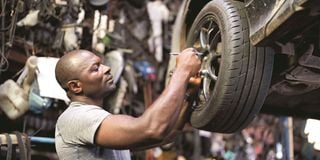
You have mentioned more than once that wheel studs and nuts can be damaged if they are overtightened. Aren’t they supposed to be very tight to be sure the wheel doesn’t fall off? And is it true that wheel nuts are likelier to work loose on the left-hand side wheels than on the right? Mugo.
Yes, wheel nuts (lug nuts) must be tight enough to ensure the chances of them coming loose are about zero.
Yes, in principle the lug nuts on the left-hand side wheels are more likely to come loose because the wheels on that side rotate anti-clockwise (the loosening direction) when the vehicle is moving forward.
And yes, overtightening can distort the nut, the stud, the integrity of the wheel rim around the stud holes, and even warp the brake rotors.
On passenger cars that means a torque (turning pressure) of 80-100 ft-lbs of force, which is what a healthy adult can achieve with arm strength using a lever only as long as the average wheel spanner.
For light trucks, a tightness of 100-120 ft-lbs torque is required, needing either a very strong adult, the use of some body weight, or an extension to the spanner arm to increase leverage.
On very heavy-duty vehicles (like large trucks) a torque of 140-160 ft-lbs is needed – definitely an extension pipe on the handle of a bigger and stronger spanner and a double-handed full body weight pull.
If a lug nut is severely overtightened, the grooves in the wheel stud or the nut or both can be distorted, so instead of the “hills and valleys” of the screw thread meshing in close contact throughout, there are gaps which the vibration and rotational force of use can shake loose.
The stud is often made of a harder steel than the nuts so the threads in the nut are more likely to distort… and are easier to replace.
The problem of the anti-clockwise driving force on the left-hand side has largely been obviated by better metallurgical technology allowing higher torque settings (especially post-1970).
But many decades ago several makes manufactured cars with “reverse-thread” nuts and studs for the left-hand wheels, and some very large trucks and equipment still use them.
As I recall, among the last cars to abandon this extra safety feature were an odd couple - Rolls Royce and the VW Beetle!
By the way, there’s another (perhaps apocryphal) anecdote about those two: with the seat pushed right to the back of its sliding range, the Beetle driver had more legroom and headroom!