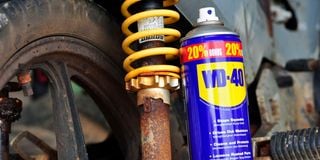
You have previously described how versatile and effective penetrating oil (e.g. WD40) can be in so many vehicle maintenance and repair situations. Should car owners be using it more often – as a preventative measure - to help look after almost everything that is made of metal and unpainted? Paul N.
Penetrating oil is so handy it should beas readily available in a workshop as a bar of soap in a bathroom. You might not use it always or for everything, but it should be there, and it can be used readily and widely.
And, by the way, it can also be useful in a bathroom! If, after working on your car, your hands are smeared with grimy grease that even soap cannot easily remove, start by spraying them with WD40. Then wash them with soap…easily.
So, the answer to your question is do always keep penetrating oil in stock and “front of mind”. Make full use of its attributes but recognise its limitations, too.
It is, first and always, an oil. Not stuff you would put anywhere and everywhere. But in oil terms it is extremely thin and runny (very low surface tension) and contains additives that dissolve iron oxide (rust).
It is thin enough to be applied as an aerosol spray.
Because it is nevertheless an oil it is slippery (a lubricant), and it expels and repels moisture (e.g.from a distributor, coil, plug caps and cables of an ignition system that has stalled in wet weather), but it is also sticky (will attract dust and other dirt).
Because it is so thin it is not robust, so it will not offer adequate or lasting protection to items that involve much heat and/or pressure (however much of it you spray on).
Because it contains solvents, it will help clean away deposits (especially rust, grease and thicker oils) but parts of it will “evaporate” quite quickly and not lubricate or protect anything for very long. The parts that don’t evaporate will stain absorbent surfaces.
Its top quality is in its name: “Penetrating”. It gets into places that more viscous lubricators and cleaners cannot reach. It can even get between the threads of a tightened (even seized) nut and bolt.
It can get into the keyholes of door and boot locks - using spray pressure to get deeper - and (thanks to its low surface tension) it can't form large droplets, so it flows and spreads over everything, even through microscopically small gaps.
It does this by harnessing the physics of “capillary action” (quite an adventure story if you want to look it up) which causes fluids to move without the help of gravity, pumping or suction.
It is happening in thousands of ways all around you all the time; in the roots and sap of all plants, rising damp in stones, tear fluid from the eye, in the wicks of candles and in fountain pens, and in kitchen towels.
It is how blotting paper - or any porous solid - works. And rust (which forms between a steel bolt and a steel nut) is a porous solid. Water has got into that space to cause the rust. Penetrating oil gets into the same space in the same way to dissolve it.
So, make use of its abilities and - to counteract the dust magnet factor -when the cleaning-unjamming job is done wipe the surface of what you have treated. If ongoing and lasting lubrication is required by the workpiece, use an appropriate oil or grease or petroleum jelly.