Time flies with great content! Renew in to keep enjoying all our premium content.
Prime
Moving tribute to Miriam Makeba in documentary
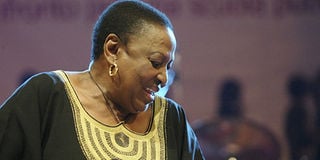
South African singer Miriam Makeba performs during a concert in Castel Volturno, south of Italy on Sunday. . PHOTO/REUTERS | FILE
During an interview on his last trip to Kenya in June this year, I asked the South African musician Hugh Masekela if he missed Miriam Makeba.
His response was swift: “Of course,” he said. “Who doesn’t miss her?” The truth is that the famed jazz trumpeter had more than a professional connection to the woman universally revered as Mama Africa.
The two were married in a relationship that lasted just two years from 1964.
When the apartheid government in South Africa banished a young Miriam Makeba into exile, they would not have realised that they were pushing the rising star onto the world stage where she would gain iconic status for her singing talent and civil rights activism.
A documentary tracing the life and times of Miriam Makeba began before her death in 2008.
Such was the global status of the woman whose parents gave her the name Zenzi (Xhosa for ‘you have no one to blame but yourself’) that it is almost surreal that her story is only just now appearing in film.
The documentary was screened for the first time in Kenya at a special event hosted by the Embassy of Finland in Nairobi last week.
Heart attack
“Mama Africa” is a project that almost never saw the light of day. Finnish director Mika Maurimaki says he was getting ready to fly out to South Africa to conduct the first interview with Makeba as she went about one of her favorite activities – cooking for friends.
This interview was put off and Makeba traveled for a performance in Italy. This was to be her last show. She suffered a heart attack after the concert and died.
It is no accident that Mika was picked by the producers to direct the story of Makeba. As a young man in Finland, he fell in love with songs like Pata Pata which were played on the radio in the 1960s.
“I watched her in concert and her songs stuck in my mind and I followed her career ever since.”
Mama Africa makes little mention of the early life of the singer and instead starts the story from her time with a semi-professional all-girl group - The Skylarks.
Her band mate from that era, Abigail Kubeka, guides us through the period and the Johannesburg township from where Makeba hailed.
“We were completely mesmerized when Miriam sang,” Hugh Masekela says in the film, “Everyone was totally in love with her.” Joe Mogotsi of the South African jazz group Manhattans, who snapped up Makeba to sing with the group, says they admired her versatility.
“Her singing always had feeling, whether it was a jazzy beat or a sentimental piece. She always gave it all her emotion.”
The director uses rare footage and a host of interviews with Makeba herself and those who knew her intimately: friends, relatives, colleagues who were there from those early days singing in the dance halls of Cape Town.
Besides Masekela, the story is also aided by the recollections of veteran South Africa musicians like Sipho Mabuse and Dorothy Masuka, Angelique Kidjo of Benin, American Paul Simon, who performed with Makeba during his famous Graceland tour of 1986, Harry Belafonte and the late Makeba’s four grandchildren.
Biggest obstacle
The 90-minute documentary premiered at the Berlin International Film Festival in February this year where it received an Audience Award and has since been screened at some of the top Festivals in the world.
Kaurismaki says the biggest obstacle to making the documentary came even before the crew started filming. “Miriam Makeba passed away just a couple of weeks before we were to start shooting with her in Johannesburg.
It was a shock and at first, I thought the whole project would be cancelled,” he says.
It was a decision between the producers and the family of the deceased that the project should go on, even though the concept changed because Makeba herself was not alive anymore.
Makeba may have been an international superstar but she remained true to her South African roots. She was forced into exile in 1959 due to her appearance in “Come Back Africa,” the internationally-acclaimed documentary that was secretly filmed to reveal the effects of apartheid on life in South Africa.
She fled to the U.S thanks to the efforts of her mentor and producer Harry Belafonte. The film moves to New York’s Village Vanguard where Makeba performed in her early days in the States before she was discovered by Belafonte.
“If I were Miriam, I would also have gone with Harry,” says the club’s owner Lorraine Gordon
Grammy Award
Makeba immediately integrated into American high society singing for Hollywood star Marlon Brando and entertaining guests at John F. Kennedy’s birthday party in 1962. She won a Grammy Award in 1966 for the album “An Evening with Belafonte/Makeba” The release of the eponymous “Pata Pata” followed soon after and her status as an international superstar was confirmed.
t comes as a surprise to see Makeba herself in the film reveal that her most popular song was never one of her favourites. “I don’t like Pata Pata. It is a song with no meaning at all, about a dance called pata pata. I would have preferred another song to be popular,” she says
Even Makeba’s personal life often had political connotations. Her marriage to firebrand American Black Panther activist Stockely Carmichael placed her under the scrutiny of the FBI and led record companies to cancel recording and touring deals with her. Piqued at the American brand of racism, Makeba is shown in one of the most poignant scenes in the film, appearing on 1970s talk show saying there was only a small difference between America and South Africa: “South Africans admit what they are.”
She soon left America for Guinea, which was to become home for her for the next 15 years, and she remained an outspoken critic of the segregationist policies of the apartheid regime. To his credit, the director of “Mama Africa” films plenty of new material in Conakry including an interview with Jean-Marie Dore, former Prime Minister of Guinea and a friend of Makeba’s.
The film culminates with Makeba’s heroic return to South Africa in 1990 at the request of Nelson Mandela who had just been released from prison. Her former husband Masekela regrets, though, that she was never quite accorded the honour that she deserved.
This is as good a story as can be told of a formidable woman who survived both exhilarating triumph and searing tragedy in equal measure: three decades in exile, four marriages, cervical cancer and the death of an only daughter.
In a memorable scene in “Mama Africa” Nelson Lumumba Lee remembers his grandmother saying, “I do not sing politics, I merely sing the truth
Unlock a world of exclusive content today!Unlock a world of exclusive content today!