Time flies with great content! Renew in to keep enjoying all our premium content.
Prime
NCBA tests new model to turn music into collateral for loans
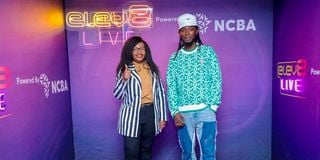
Kenyan music producer and artist Morris Kobia, better known as Motif Di Don (right), with NCBA Bank Group Director of Marketing, Communications, and Citizenship Nelly Wainaina during an interview in Nairobi on October 21, 2025.
Banks have begun to recognise music as more than just art. They are exploring ways to treat songs, catalogues, and royalties as collateral for loans, a move that could unlock long-awaited financing for the creative industry.
For decades, musicians have self-financed their careers, paying out of pocket for studio sessions, production, promotion, and distribution. Without formal credit structures, many musicians and producers are unable to make songs due to financial challenges.
NCBA is now testing a new model to turn music into collateral for loans.
“The creative sector contributes more than Sh110 billion to the economy, yet most artistes still struggle to access funding because their work doesn’t fit traditional banking models,” Nelly Wainaina, NCBA’s Group Director of Marketing, Communications, and Citizenship, says. “We’re looking at ways to recognise music masters and catalogues as collateral, to make creative work truly bankable.”
Morris Kobia, better known as ‘Motif Di Don’, has begun piloting the use of a catalogue of work as collateral for loans.
Kenyan music producer and artist Morris Kobia, better known as Motif Di Don during an interview in Nairobi on October 21, 2025.
Photo credit: Lucy Wanjiru | Nation Media Group
“Music production in Kenya is expensive,” ‘Motif Di Don’ says. “Sometimes you find a talented artiste, but they can’t afford to record, mix, or even release properly. They have to hustle just to get one song out.”
Producers also struggle with finances, and investing in an artiste is a leap of faith. “You might record a song for someone knowing they don’t have money, then hope it blows up and you split earnings later. It’s not sustainable,” he says.
On average, a professionally produced music track can cost between Sh30,000 and Sh100,000, he says, depending on quality, studio time, and the team involved. That figure doesn’t include video production, promotion, or marketing.
“People think a hit just happens,” he says. “But behind every hit are bills that have to be paid.”
The lack of access to structured financing has long been a bottleneck for Kenyan musicians. “You can’t walk into a bank and say you need a loan to shoot a music video; they won’t take you seriously,” he says.
“Yet music is a product that generates money. The problem is that most people don’t see it that way. If we can get to a point where an artiste can walk into a bank and say, ‘Here’s my catalogue, here’s my streaming revenue,’ and get a loan, that’s real progress. That’s when the system starts working for creatives, not against them.”
Ms Wainaina says the idea to make creative work bankable was born out of both data and conviction. “We’re in the business of money,” she says. “So if there’s an entire sector where people keep saying, ‘We don’t have money,’ that’s exactly where banks should come in.”
She says the NCBA chief executive John Gachora, also played a role.
“Our CEO is very passionate about music. Before he became an engineer and a banker, he had written 25 songs. He never recorded them, but that experience stuck with him. He kept asking, ‘Why should a young person with talent not be able to access financing to make music and earn from it?’”
Ms Wainaina says she, too, connects personally to the creative industry. “In high school, I was a soloist,” she says.
NCBA Bank Group Director of Marketing, Communications, and Citizenship Nelly Wainaina during an interview in Nairobi on October 21, 2025.
Photo credit: Lucy Wanjiru | Nation Media Group
“Before joining NCBA, I worked at Coca-Cola, where I was part of the Coke Studio initiative. That experience showed me the power of music in shaping careers and communities, but most of those artistes were already discovered. We wanted to go a step earlier, to the stage where talent is still raw and opportunity feels out of reach.”
When NCBA began mapping out where to begin in the creative space; between film, fashion, and music, the answer was clear. “Music is universal,” she says. “It cuts across everything and touches everyone. But when I started asking around, I realised I didn’t even know who the producers behind the biggest Kenyan songs were. I asked a friend, ‘Who’s the best producer in town?’ and they said, ‘Motif Di Don.’ I couldn’t even pronounce his name, but I said, ‘Take me to him.’ That’s how it all began.”
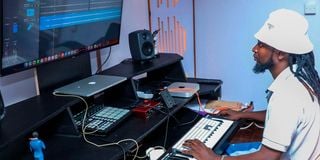
Motif Di Don’s journey started in an unlikely place, the University of Nairobi, where he was studying commerce. He picked up music production on the side, experimenting with beats and software in his hostel room. “I started learning production on the side because I wanted something to do apart from my studies. I thought the skill was good, making beats,” he says.
His early beats caught the attention of established names like Khaligraph Jones, and some of Africa’s biggest stars, including Sarkodie, KO, Rayvanny, Mr Eazi, Reekado Banks, Bien Aime, Tanasha Donna, Davido, and Otile Brown.
He says his first major placement with Khaligraph changed everything. “Khaligraph believed in my sound when no one else did,” he says. “At the time, there was no structure, no blueprint for producers to follow. You just had to trust the process and keep creating.”
‘Motif Di Don’ has partnered with NCBA to help emerging artistes produce music. “We don’t just want to sponsor concerts or donate equipment,” Ms Wainaina says. “We want to help creatives make money, and keep it.”
“We’re co-creating a product with the artistes themselves, asking them how much they need, how often they could repay, and what kind of support they’d want alongside the loan.”
Using intellectual property (IP) as collateral remains a new concept even in global banking. “A lot of banks worldwide have not figured out how to value IP,” she says.
“That’s why music production has remained difficult to finance. So right now, we’re co-creating a product with the artistes themselves, asking them how much they need, how often they could repay, and what kind of support they’d want alongside the loan.”
Kenyan music producer and artist Morris Kobia, better known as Motif Di Don during an interview in Nairobi on October 21, 2025.
Photo credit: Lucy Wanjiru | Nation Media Group
“Hopefully, by December, we’ll launch the first version of the product. We’re just fine-tuning how our credit systems can be flexible enough for people who don’t earn a fixed salary. We know artistes don’t have payslips, but that doesn’t mean they don’t have income.”
Beyond lending, NCBA is investing heavily in financial literacy for creatives. “Two weeks ago, we brought in a batch of upcoming artistes from Motif’s programme,” she says.
“Our investment bankers taught them how to open and manage accounts, how to save, how to let their money earn interest while they sleep, and most importantly, how to stretch their earnings during dry spells between hits. They make money from performances and productions, but it’s how you use that money that matters,” she says. “We’re teaching them how to make it last, how to invest, and how to make informed financial decisions.”