Time flies with great content! Renew in to keep enjoying all our premium content.
Prime
Nuru Bahati: Artist who has popularised biro portraits
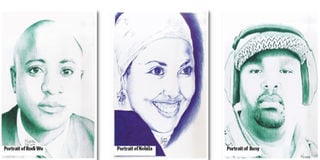
Nuru Bahati Shukrani admits he started doing biro art in secondary school days in Mombasa.
“Our art teacher, Mrs Otieno, assigned us a school project to showcase our national heroes by drawing them with biro pens,” said Bahati who’s been specialising in Biro Art ever since.
“That was in 1998, and my biro drawings were so successful, they earned me awards in several art competitions at the Coast, including those in school and two at the Reef Hotel in 1999 and 2000,” added the artist who came to Nairobi to attend Buru Buru Institute of Fine Art in 2003 and has been in the capital city ever since.
Having majored in painting and drawing, Bahati’s time at BIFA simply confirmed something he already knew, which was that he had a special talent for drawing life-like biro portraits - drawn in the most common biro colours—black, blue, red and occasionally pink and green; but it’s the delicate realism of his drawings that has earned him an ever-expanding client base.
Price tag
“I don’t put a price tag on my art,” said Bahati who trusts that people will pay him according to both the value of his work and the client’s capacity to pay.
“My clients also know I take a philanthropic approach to my art,” he says. “I give 10 per cent to fellow artists who may be stuck or in need of a bail-out for some reason. Then I give another 40 per cent to various orphanages,” adds.
That means he only takes home half of what his clients pay him, but Bahati says his philanthropic approach to his art reflects a wider vision of how he values contemporary Kenyan art.
“To me, art isn’t merely for decoration. I see it as part of our heritage and I believe Kenyans are increasingly coming to see it that way too.”
Bahati’s commitment to creating and promoting art that is by, for and about Kenyans takes on tangible form in the label he established several years ago called ‘Mkenya’.
“Basically I launched Mkenya in order to sensitise my fellow Kenyans to take pride in their identity as Kenyans through art of all kinds,” he explains.
Acknowledging that “everything about my life has to do with art,” Bahati isn’t just an artist whose main medium in the biro pen, although he’s definitely an advocate for the ink pen, be it a Bic, Speedo, ballpoint or fountain pen.
He also enjoys helping other artists, be they poets, painters, graphic novelists, sculptors or storytellers to plan and execute their public events.
Sometimes he’ll serve as their master of ceremonies as he did recently for the three ceramicists, Caroline Khakula, Emily Nyabere and Lilian Barongo who call themselves the House of Nubia and who had an exhibition at the United Nations Recreation Centre.
Philanthropist
On other occasions, he’ll take on larger tasks as he did last year when he worked closely with the graffiti artist Swift Elegwa to give the Paa ya Paa Art Centre an artistic ‘uplift’ by helping to paint PYP’s long mabati fence in colourful imagery and organic graffiti.
He also helps fellow artists working behind the scenes as he did last week, assisting visual artist Sammy Lutaye with the organisation of his one-man exhibition ‘Different Strokes II’ which is currently up at the Michael Joseph Centre.
One of the high points of Bahati’s artistic career came when he took part in the Heart of Art exhibition and silent auction, organised by Zihan Kassam and Joy Mboya with support from Hamed Ehsani, MD of the Village Market.
It was a show in which he and more than a dozen Kenyan artists donated their artwork to assist hunger-stricken communities in Northern Kenya.
The other ‘worthy cause’ that Bahati has plenty of time for is the poets, particularly those who participate in the open mic and forum currently happening every Friday afternoon at PAWA254 called ‘Fatuma’s Voice.’
Fatuma has been compared to Wanjiku, the ‘every woman’ [mwananchi] figure who’s been popularised by Gado, the illustrator.
According to Bahati, the Kenyan poets (including himself) who take part in Fatuma’s Voice perform poetry aimed at raising awareness about current social issues and promote positive change.
“People come to Fatuma’s Voice to share their problems and seek solutions. In the process, they channel their emotions through poetry.”
Bahati’s portraits start from Sh10,000, but he says the price is always negotiable.
Unlock a world of exclusive content today!Unlock a world of exclusive content today!