Time flies with great content! Renew in to keep enjoying all our premium content.
Prime
Rearing a cow can benefit from balanced score card tool
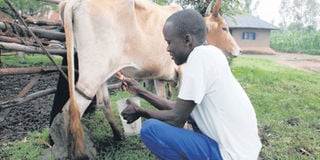
Dairy farmers should employ the balanced score card method to improve production. PHOTO | JACOB OWITI
I recently helped some businesses develop Balanced Score Cards (BSC). The most important thing is to understand that BSC is about having balanced targets.
This means that to realise your vision all the elements of the business must be in a healthy shape. It is similar to having a work-life balance.
Last week, hundreds of Murang’a County alcoholics graduated from a rehabilitation centre in the Kaa Sober initiative.
Those who were farmers before alcohol or drugs took a toll on them were each given a cow. They are required to take care of it, join a milk cooperative and start paying back for the investment in two months.
The only condition is that if they go back to alcohol or drugs they forfeit the cow. If acquiring a cow is setting up a business, then we should apply the BSC to the venture.
BSC looks at four broad perspectives; namely financial, customer, business processes, and learning and growth.
Financial perspective looks at costs and revenues
The financial perspective here largely involves milk produced by the cow in terms of quantity and amount of money received.
It also involves the cost of feeds and maintenance, planned payback period to clear the loan, the payment period for milk deliveries and profit. If the cow calf’s that is a bonus. The sale of milk, calves, manure and excess feeds make up revenue streams.
Customer perspective; route to market
The customer perspective includes the county government which owns the cow while the target is staying away from bars and ensuring good relationships.
The farmers’ co-operative society, which buys the milk, should also be satisfied with quality.
If the farmer expects to sell some milk to neighbours, they need to be satisfied with quality and the former alcoholic needs to talk to them politely. He should also ensure timeliness in milk delivery.
Business processes deals with internal systems
In terms of business processes, the farmer should have a system that ensures the cow is fed on a balanced diet and on time. He should also ensure that the cowshed is cleaned every morning and synchronise milking with milk delivery times.
He should keep records of the cow in order to know its reproductive cycle and when it is likely to be on heat. He should also use the cow dung to improve nappier grass productivity.
Learning and growth is about people and innovation
Leaning and growth looks at people and how they grow in knowledge and skills. The farmer in this case may consider his own health; treat his family well since they are his main labour force in addition to other farm hands.
He should also have a growth plan in terms of adding more cows and a succession plan for when the cow will grow old while ensuring his children go to school.
He should adopt modern animal husbandry and learn through extension officers, other farmers, agricultural shows and media programmes.
He may also advance into automation such as milking machines and grass cutters, introduce piped music so that the cow can be happy and produce more milk.
He can also start producing and using biogas from cow dung. I hope this has enlightened you on how to apply the BSC performance management tool.
The writer is the Marketing Director of SBO Research. [email protected], Twitter @bngahu
Unlock a world of exclusive content today!Unlock a world of exclusive content today!